Inventory control for distributors: counts, lots, FIFO, barcodes
Four things: cycle counts that check a few bins every day instead of one shutdown count a year; lot or serial numbers on what you receive and ship, so a recall finds the customers in minutes; a valuation method, usually FIFO, applied the same way every year; and barcodes scanned at receiving, picking and counting, so stock changes when goods move, not when someone types.
Pujan Motiwala · Written for US job shops and small manufacturers · QuickBooks facts checked against Intuit's pages on
How does cycle counting replace the annual count?
By counting a small set of locations every day, so every item is counted several times a year and errors are found while someone still remembers why. An annual physical count shuts the warehouse for a day or two and is wrong again within a week.
| Class | Share of items (typical) | Count | Why |
|---|---|---|---|
| A | The few items that are most of the dollar value | Monthly or more | Errors here cost the most |
| B | The middle | Quarterly | |
| C | The many cheap items | Once or twice a year | Errors cost little |
How many counts is that? A made-up distributor with 1,200 items: 120 A items counted monthly (1,440 counts a year), 360 B items quarterly (1,440) and 720 C items twice a year (1,440). That's 4,320 counts over 250 working days, about 17 bins a day: half an hour for one person, instead of a closed warehouse.
Rules that keep counts honest:
- Blind counts. The counter sees the bin, not the expected quantity.
- Count, then compare, then recount. A difference over a set tolerance gets a second count by someone else before anything is adjusted.
- Freeze only the bin, not the warehouse. Movements into or out of the bin wait until the count is posted.
- Every adjustment has a reason (damaged, miscount, mis-pick, receiving error), so the cause can be fixed.
How do lot and serial numbers help in a recall?
They turn "who got that batch?" into a lookup. A lot number ties a quantity to a batch from a supplier or a production run; a serial number ties one unit to its own history. Record them at receiving and again at shipping, and a recall, a warranty claim or a customer's quality question becomes a lookup: which customers got lot 24-117, and what else came from that supplier's batch.
What it takes: the lot or serial captured at receiving (scanned from the supplier's label where there is one), stock held by lot in each location, picking that records which lot went into each order, and returns that come back to the same lot. Material reserved for one order should be reserved by lot too; see QuickBooks Online inventory for where an accounting system stops.
Which valuation method should a distributor use?
Usually FIFO, chosen with your accountant and applied the same way every year. The IRS describes FIFO (first-in first-out) as assuming the items you bought or produced first are the first sold or used. When prices are rising, FIFO gives a lower cost of goods sold and a higher closing inventory than LIFO. Publication 538 also covers average cost, LIFO (which has its own rules and an election) and changing methods, which needs IRS consent. Pick a method with your accountant and apply it the same way every year.
FIFO as a valuation method is not the same as picking the oldest stock first. A system should do both: value stock by the method you chose, and suggest the oldest lot (or the soonest to expire) when picking.
Do you need GS1 barcodes?
Only for products you sell to retailers: barcodes on your own bins and locations need no registration, and any internal code works. Barcodes on products you sell to retailers are different: retailers expect GS1 numbers, which identify your company as the brand owner. GS1 US licenses either a single GTIN for a product or a GS1 Company Prefix that numbers many products, cases and pallets; its site gives the current prices.
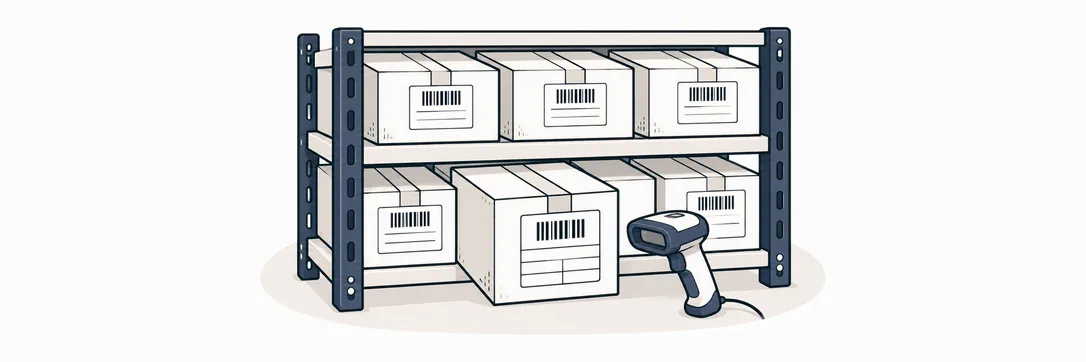
Scan at the moments stock moves: receiving against the purchase order, putaway to a bin, picking against the order, packing, and counting. A scan that doesn't match (wrong item, wrong lot, over the ordered quantity) should stop the person there, not show up in next month's count.
Can QuickBooks do this, or do you need a stock system?
QuickBooks Online can't: it has no bins, lots or serial numbers. QuickBooks Desktop Enterprise can with Advanced Inventory, on its Platinum and Diamond plans: three levels of location (such as row, shelf and bin) and serial or lot numbers with expiry dates. Beyond that, cycle-count plans, blind counts and scanning at every movement usually mean a stock system beside QuickBooks; see QuickBooks Online inventory.
What should you look for in a system?
Five things, each of which you can test in a demo:
- Locations and bins, with stock by lot or serial in each.
- Cycle count plans by ABC class, blind counts and adjustment reasons.
- Lot capture at receiving and picking, and a trace report both ways (supplier to customer, customer to supplier).
- Valuation by your chosen method, posted to the books (see QuickBooks for manufacturing).
- Scanning on phones or handhelds at every movement.
For how the systems that do this compare, see choosing an ERP, and for building one to fit, custom vs off-the-shelf ERP.
Quoted from Intuit's pages (5)
“Track inventory your way with three levels of location tracking (e.g., row, shelf, and bin; section, area, pallet).”
Intuit, Desktop Enterprise Advanced Inventory
“QuickBooks Desktop Enterprise lets you track inventory with serial numbers, lot numbers, with expiration dates when you turn on Advanced Inventory”
Intuit help, serial or lot numbers (QuickBooks Desktop Enterprise)
“The FIFO (first-in first-out) method assumes the items you purchased or produced first are the first items you sold, consumed, or otherwise disposed of.”
IRS Publication 538, inventories (FIFO)
“A GS1 Company Prefix allows businesses to get multiple barcodes at a single time, as well as identify locations, mixed cases, create coupons, and create higher levels of packaging like a case or pallet.”
GS1 US, How to get a UPC barcode
“Barcodes from GS1 identify your company as the brand owner of that product, which is a valuable piece of information that retailers look for!”
GS1 US, How to get a UPC barcode
Quotes, jobs, routings, stock and shop-floor time in one system, with QuickBooks kept for the books. Start with a working prototype of your main workflow, on your own data, in 2 weeks for $1,500, credited to the build if you continue.
Stock, reservations and approvals in a live system, with sample logins: try the inventory demo.
Official sources
- Advanced Inventory (QuickBooks Desktop Enterprise). Intuit QuickBooks, November 6, 2026.
- Publication 538, Accounting Periods and Methods. Internal Revenue Service, November 3, 2026.
- How to get a UPC barcode. GS1 US, November 3, 2026.
What this page is not
A guide written by Ahrom Labs, a software company that builds operations systems for manufacturers. Where it describes QuickBooks, the facts come from Intuit's own pages on the date shown, and Intuit changes its plans often: check your edition before relying on it. QuickBooks is a trademark of Intuit Inc.; Ahrom Labs is not affiliated with Intuit. Not accounting or tax advice. Last updated .
Talk to us about your systems.
Tell us what's held together with workarounds right now. We reply to every message ourselves.