How interior work is measured for a BOQ (IS 1200)
Floors, ceilings, paint and woodwork have an Indian Standard for measurement, IS 1200: measure net as fixed, deduct openings only above a set size, and price skirting by running length with its height stated. Modular kitchens and wardrobes have none, so a BOQ line must say its basis: the same wardrobe can be 60 sq ft or 8 running ft.
Pujan Motiwala · Standards checked against the BIS catalogue on
Which trades have a measurement standard
IS 1200 is the Indian Standard method of measuring building work, in parts by trade. Four parts cover most of an interior job; modular furniture is not one of them.
| Work | Standard | Unit in the standard |
|---|---|---|
| False ceilings and wall linings | IS 1200 (Part 10) | square metres, measured flat |
| Floors, dado and skirting | IS 1200 (Part 11) | square metres; skirting in running metres |
| Paint on walls and ceilings | IS 1200 (Part 13) | square metres |
| Woodwork, panelling and joinery | IS 1200 (Part 21) | square metres for boarding, with its thickness |
| Modular kitchens, wardrobes, lofts | None | whatever the BOQ states |
Interior quotes in India are usually written in sq ft and running ft rather than the standard's metric units: 1 sq m is 10.764 sq ft, and 1 m is 3.281 ft. The rules below are the same in either unit.
Floors, dado and skirting
Part 11 measures floor finishes and dado in square metres, and skirting in running metres with its height stated; mitres, stops and returned ends are part of the skirting item, not extra. Nothing is deducted for embedded items up to 0.1 m² each. A strip of finish 30 cm wide or less that doesn't match the general floor is measured by running length; wider than that, by area.
For a BOQ that means three lines, not one: the floor by area, the skirting by length with its height, and any border or threshold strip as its own line.
False ceilings
Part 10 measures ceilings flat, in square metres, net as fixed. An opening up to 0.4 m² (a light cut-out, a grille) is not deducted and not charged for; a bigger opening is deducted in full and the work of forming it is measured separately. Boarding on curved surfaces up to 15 cm wide is its own item.
Coves, drops and bands are not flat ceiling, which is why the false ceiling items price them by running length: say their girth (height plus width) in the line.
Paint
Part 13 measures walls, ceilings and sloping surfaces separately, and every item states the number of coats. Openings up to 0.5 m² each are not deducted, and their reveals are not added. A line reading "painting, 900 sq ft" leaves out both: which surfaces, and how many coats of what.
Woodwork and panelling
Part 21 measures woodwork net as fixed: nothing is added for shape, joints or wastage. Boarding, which the standard says covers panelling, shelves and almirah linings, is measured in square metres with its finished thickness stated. Wastage belongs in the rate, not the quantity.
Modular kitchens, wardrobes and lofts
No Indian Standard sets how modular units are measured, so the trade uses several bases, and two quotes on different bases can't be compared:
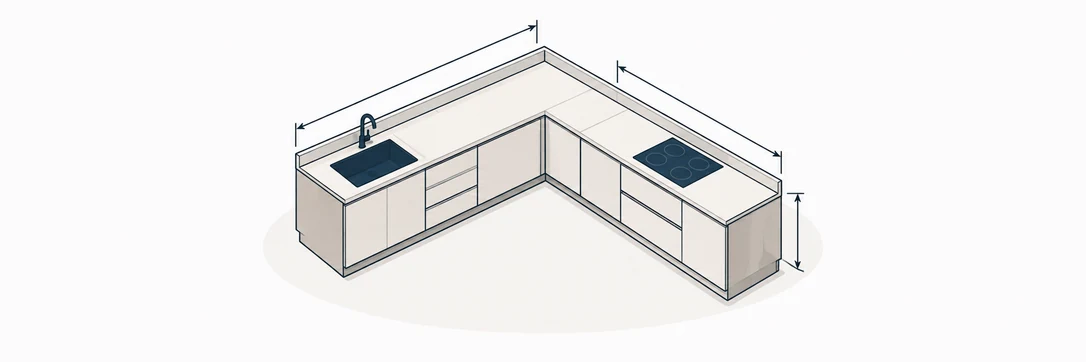
- Kitchen cabinets: usually by running length along the wall, base and wall units as separate lines, corners counted once. Say whether the plinth and back panels are included.
- Wardrobes: usually by front elevation, height × width. Say whether the loft, side panels and internal drawers are in it; lofts are often a separate line.
- Tall units and accessories: per unit, size stated.
The same wardrobe, 8 ft wide and 7 ft 6 in high, is 60 sq ft by elevation or 8 running ft along the wall. At ₹1,450 per sq ft it costs ₹87,000; quoted per running ft, the same price is ₹10,875 a foot. A BOQ that asks for "wardrobe, per sq ft" without saying which area gets prices that can't be put side by side.
Write the basis into every modular line, for example: "measured by front elevation area, excluding loft and drawers". The BOQ checker flags modular lines that don't, and its dimension box works out the quantity from 8' x 7'6".
Boundary
The rules come from the public copies of IS 1200 Parts 10, 11, 13 and 21 linked below. They are older editions, and newer revisions may differ in detail; check the current edition in the BIS catalogue before relying on a figure in a contract. The modular bases are trade practice, not a standard. Each trade's items, with a line to start from, are in the item library.
Paste a BOQ from Excel and see what each line leaves open, then print it as a quotation.
Designer Ops keeps your own BOQ library and every quote, turns an accepted quote's payment stages into invoices, then runs the project: orders, site visits and the workshop. Try the live demo · system for interior designers · what to require from one
Official sources
- Indian Standards catalogue (Know Your Standards). Bureau of Indian Standards, October 23, 2026.
- IS 1200 (Part 10), ceiling and linings, public copy of the 1973 edition. Bureau of Indian Standards, via Public.Resource.Org, January 1, 1973.
- IS 1200 (Part 11), paving, floor finishes, dado and skirting, public copy of the 1977 edition. Bureau of Indian Standards, via Public.Resource.Org, December 1, 1977.
- IS 1200 (Part 13), whitewashing, colour washing, distempering and painting of building surfaces, public copy of the 1994 edition. Bureau of Indian Standards, via Public.Resource.Org, January 1, 1994.
- IS 1200 (Part 21), wood-work and joinery, public copy of the 1973 edition. Bureau of Indian Standards, via Public.Resource.Org, January 1, 1973.
What this page is not
A guide written by Ahrom Labs; not legal, tax or engineering advice. Indian Standards are cited by number and title from the BIS catalogue, not quoted; the standard governs wherever this page differs from it. No rates are given: they change with city and month. Last updated .
Talk to us about your systems.
Tell us what's held together with workarounds right now. We reply to every message ourselves.