ASME Section VIII: Division 1 vs 2 vs 3
Section VIII sets the rules for pressure vessels in three Divisions. Division 1 designs by rule with a design factor of 3.5 on tensile strength and covers most vessels. Division 2 uses a factor of 2.4, so walls are thinner, in return for more analysis, a User's Design Specification and a certified design report. Division 3 is for very high pressures. Each needs its own certificate: U, U2 or U3.
Pujan Motiwala · Written to the ASME BPVC 2025 Edition · checked against ASME's and the National Board's public pages on
Video chapters (10)
- 0:00ASME Section VIII Overview: Division 1 vs. 2 vs. 3
- 0:18Scope & Paragraph U-1 Exclusions (15 psi, 6 in ID & Fired Boilers)
- 0:38Side-by-Side Comparison: Margins (3.5 vs 2.4), Stamps (U, U2, U3) & Forms
- 0:58When Division 2 Beats Division 1 on Cost (Above 2 in, Alloys & Cyclic)
- 1:18When Division 3 Is Used (Above 10,000 psi, Fracture Mechanics & U3)
- 1:38Routing Real Vessels to Division 1, 2, or 3 (3 Shop Scenarios)
- 1:58Certificate Limits (U ≠ U2), Unstamped Vessels & NB-370 State Rules
- 2:185 Traceable Records Behind Every Division 1 U-1 / U-1A File
- 2:38Compiling Division 1 & Section I Data Packages in Boiler ERP
- 2:56Full Comparison Table, UG-27 Calculator & Related Guides
What does ASME Section VIII cover?
Section VIII is the Code's pressure vessel section: tanks, columns, reactors, heat exchangers, receivers and other vessels that hold internal or external pressure, in three Divisions. Fired equipment that generates steam belongs to Section I instead. Division 1's scope paragraph (U-1 in the 2025 Edition) excludes some equipment outright, among them vessels for 15 psi (1 bar) or less and vessels of 6 in (152 mm) inside diameter or less, which is why many low-pressure tanks are built to other standards. The Code text is ASME's and paid; this guide cites paragraphs and explains them, and your copy of the 2025 Edition is the authority.
What is the difference between Division 1 and Division 2?
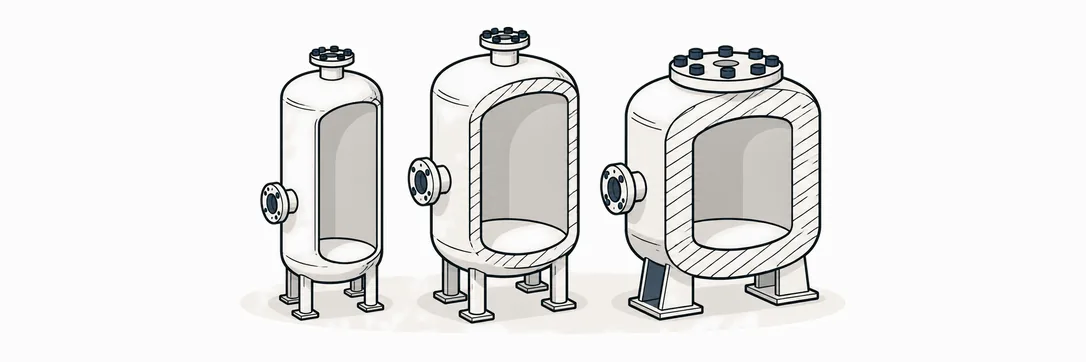
The difference is the design margin and the engineering that pays for a smaller one. Division 1 sets allowable stresses with a design factor of 3.5 on tensile strength and designs mostly by formula; Division 2 uses 2.4 and designs by rule or by analysis, with stricter material and examination rules and more paperwork.
| Division 1 | Division 2 | Division 3 | |
|---|---|---|---|
| Approach | Design by rule: formulas and charts | Design by rule or by analysis (stress analysis, finite elements) | Design by analysis, with fracture mechanics |
| Design factor on tensile strength | 3.5 | 2.4 | Based on yield, with further checks |
| Typical use | Most vessels | Large, thick or alloy vessels where steel is the bigger cost | Very high pressure, generally above 10,000 psi (690 bar) |
| Owner's input | Design conditions on the order, or ASME's U-DR-1 / U-DR-2 forms | A User's Design Specification | A User's Design Specification |
| Design certification | The manufacturer | A Manufacturer's Design Report, certified as the Division requires | As Division 2, and more |
| ASME certificate | U (UM for miniature vessels) | U2 | U3 |
| Data report | U-1 or U-1A | A-1 | K-1 |
The certificate names and forms are from ASME's certification page and data report forms list. The same vessel needs less steel under Division 2, so it pays mainly on large, thick or expensive-alloy vessels; elsewhere the extra analysis and examination cost more than the steel saved.
When is Division 3 used?
Division 3 is for very high pressure, generally above 10,000 psi (690 bar): isostatic presses, high-pressure reactors, some hydrogen storage. It designs by analysis with fracture mechanics, needs the U3 certificate, and is reported on Form K-1 (K-2 for parts). It is a specialist field, and few shops hold the certificate.
How do I choose between Division 1 and Division 2?
Start with Division 1 unless the vessel gives a reason not to. More shops hold the U certificate, more inspectors know it, and the owner's paperwork is lighter. Consider Division 2 when:
- the wall gets thick (a rough sign: shells over about 2 in, 50 mm);
- the material is expensive (stainless, nickel alloys, clad plate), so thinner walls save real money;
- the vessel is cyclic and needs a fatigue assessment anyway.
The Division also decides who can build it: a fabricator with only a U certificate can't build or stamp a Division 2 vessel.
Can a shop with a U certificate build Division 2 vessels?
No. Division 2 vessels need the U2 certificate, which ASME lists separately from U, with its own required code books (Section VIII Division 2 instead of Division 1). A U holder that wants Division 2 work applies for U2 and goes through a joint review for it. See ASME stamps and how to get the U stamp.
Does a vessel under 15 psi need a U stamp?
Not under Section VIII: Division 1's scope excludes vessels for 15 psi (1 bar) or less, so there is nothing to stamp them to. A buyer can still ask for Code construction in the order, and the law where the vessel is installed sets its own scope. Check the jurisdiction's rules before assuming a small or low-pressure vessel is exempt; see US and Canadian boiler laws.
Can a vessel be built to Section VIII without the U stamp?
A shop can design to the Section VIII formulas without a certificate, but the vessel isn't a Code vessel: there is no Authorized Inspector, no Manufacturer's Data Report and no Certification Mark, and it can't be registered with the National Board. Whether that is acceptable is a legal question for the place of installation. The National Board's stamping table (2024 Synopsis) lists the ASME stamps each jurisdiction requires: most list U, while some do not include it (Florida, Louisiana, Montana, New Mexico, South Dakota and West Virginia among them), and Idaho lists none.
What paperwork does a Division 1 vessel need?
A Division 1 vessel's file holds:
- the design calculations: shell thickness, heads, nozzles and openings, flanges, supports;
- material certificates (MTRs) traced to each part by heat number;
- welding procedures and welder qualifications (WPS, PQR and WPQ), with each welder's continuity;
- NDE reports, heat treatment charts and the hydrostatic test record;
- the Manufacturer's Data Report, U-1 or U-1A, signed by the manufacturer and the Authorized Inspector.
ASME also publishes User's Design Requirements forms, U-DR-1 for single-chamber and U-DR-2 for multi-chamber vessels, for the owner to state design conditions.
What does our software keep for a Section VIII vessel?
Our US boiler demo builds the record package for a Division 1 vessel from the job's own records: a Form U-1A layout (our own, carrying the form's fields, not a copy of ASME's form), the weld map with welder stamps, WPS and PQR, QW-322 continuity, MTRs by heat number, NDE, PWHT and the hydro test record. It covers Division 1 vessels and Section I boilers, not Division 2. See ERP for boiler and pressure vessel shops.
Quoted from the official text (6)
“U2 - Pressure Vessels (Alternative Rules for Pressure Vessels)”
ASME certification page, Section VIII Division 2
“U3 - High Pressure Vessels”
ASME certification page, Section VIII Division 3
“Manufacturer's Data Report for Pressure Vessels (Alternative Form for Single Chamber, Completely Shop- or Field-Fabricated Vessels Only)”
ASME Data Report Forms, Section VIII Division 1
“User's Design Requirements for Single Chamber Pressure Vessels”
ASME Data Report Forms, Section VIII Division 1
“Manufacturer's Data Report for High Pressure Vessels”
ASME Data Report Forms, Section VIII Division 3
“BPVC Section VIII-Rules for Construction of Pressure Vessels Division 1”
ASME Required Code Books, U and UM certificates
WPS and PQR registers, welder continuity, heat numbers from receipt to nameplate, and the data report package: the records a Code shop keeps, in one system.
A boiler manufacturer's system, from enquiry to dispatch and the IBR folder, with sample logins: try the live demo.
A boiler and pressure vessel shop's system, from inquiry to shipping and the ASME data report package, with sample logins: try the live demo. Fixed price, scope agreed before work starts: see the prices.
Official sources
- Boiler and Pressure Vessel Certification. ASME, November 1, 2026.
- ASME Data Report Forms. ASME, November 5, 2026.
- Required Code Books. ASME, November 5, 2026.
- 2025 ASME Boiler and Pressure Vessel Code (Section VIII, Divisions 1, 2 and 3). ASME, July 1, 2025.
- NB-370 Synopsis: Stamping Requirements by Jurisdiction. The National Board of Boiler and Pressure Vessel Inspectors, June 14, 2024.
What this page is not
A guide written by Ahrom Labs, not engineering advice, and not yet reviewed by an Authorized Inspector. The ASME Code is copyrighted and sold by ASME: paragraphs are cited by number and explained in our own words, never reproduced. Check every figure against your copy of the 2025 Edition and with your Authorized Inspector before relying on it. Last updated .
Talk to us about your systems.
Tell us what's held together with workarounds right now. We reply to every message ourselves.