e-Invoice and e-way bill: what is ready and what needs NIC access
It prepares them but does not connect to NIC yet. For an issued invoice it builds and checks the e-invoice data in the NIC schema, downloads the JSON, and stores and prints the IRN and signed QR once entered. The e-way bill is prepared from the packing list. A live connection needs the company's own NIC access.
Pujan Motiwala · Written for Indian manufacturers and their CAs · Checked against the system's own finance notes and code on

When does a manufacturer need them?
- e-Invoice: a business whose aggregate turnover is above ₹5 crore must report its B2B invoices to the Invoice Registration Portal and print the IRN and QR code it returns. The limit has been five crore rupees since 1 August 2023 (quoted below). Many boiler and pressure-vessel makers are above it.
- e-Way bill: needed before moving goods of consignment value exceeding fifty thousand rupees (rule 138), with some states setting their own limit for movement inside the state.
The system holds both limits as threshold rows with their sources (see statutory rates and approvals), and the invoice list flags each invoice that needs an e-invoice or an e-way bill.
What is ready for the e-invoice?
From an issued invoice, Accounts can:
- build the e-invoice data in the NIC schema, version 1.1: seller and buyer GSTIN, document details, each line with HSN, quantity, unit, taxable value and tax, round-off and totals;
- see a list of anything missing or invalid before it goes anywhere (a GSTIN, a state code, an HSN code);
- download the JSON, which can be uploaded on the portal;
- enter the IRN, acknowledgement number and date and the signed QR returned, which are stored on the invoice and printed on the invoice PDF.
Not handled yet: e-invoices for credit notes and for reverse-charge invoices. Common units are mapped to the portal's unit codes, and others go as OTH. How invoices are made is in sales invoices and GST.
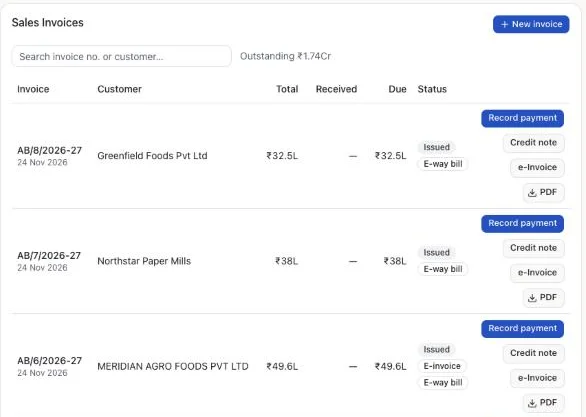 The invoice list tags each invoice that needs an e-invoice or an e-way bill.
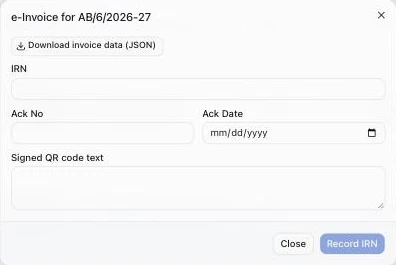 The e-invoice panel: download the JSON for the portal, then record the IRN, acknowledgement and signed QR it returns.
What is ready for the e-way bill?
From the packing list, Dispatch can prepare the e-way bill data, record the number and cancel within the allowed window. A client for the government's NIC e-way bill system is built to its published specification, with each company's credentials stored encrypted. It has never run live, because it needs the company's own NIC access. Until then, the e-way bill is generated on the government portal and its number recorded here. The registers are in dispatch and freight.
What is needed to switch them on?
The company's GSTIN access to the NIC e-invoice and e-way bill systems, set up for API use, and a test on NIC's sandbox before the first live document. Until that is done, nothing on this page should be read as live: the data is prepared and checked in the system, and a person does the portal step.
A worked example
Invoice AB/6/2026-27 on the demo goes to a registered customer, so the invoice list tags it "E-invoice". Accounts opens its e-Invoice panel and downloads the JSON. The data is checked first, so a missing GSTIN, state code or HSN code is listed before anything goes to the portal. The JSON is uploaded on the e-invoice portal, and the IRN, acknowledgement number and date and the signed QR it returns are entered back. From then on the invoice PDF prints the IRN and the QR. The invoice's ledger entry doesn't change: e-invoicing reports the invoice, it doesn't post anything.
Who does what?
| Step | Accounts | The system | Your CA or GST practitioner |
|---|---|---|---|
| Which invoices need it | — | Flags them by the e-invoice threshold row | Confirms the company is in scope |
| Data | Fixes what the check lists | Builds and checks the NIC schema 1.1 JSON | — |
| IRN | Uploads on the portal, records the IRN and QR | Stores and prints them | — |
| e-Way bill | Generates it on the portal, records the number | Stores it with the packing list | — |
What it doesn't do yet
- No live connection to NIC: the IRN and e-way bill come from the portal, by a person.
- e-Invoices for credit notes and for reverse-charge invoices are not handled.
- Units outside the common ones are sent as OTH, and the cancellation window is not confirmed.
Common questions
Does the ERP generate the IRN automatically?
Not yet. It builds and checks the e-invoice JSON; a person uploads it on the portal and records the IRN and signed QR, which the invoice then prints.
What is needed for a direct NIC connection?
The company's own GSTIN access to the NIC e-invoice and e-way bill systems set up for API use, and a test on NIC's sandbox before the first live document.
Which invoices need an e-invoice?
B2B invoices of a business whose turnover is above the limit, five crore rupees since 1 August 2023. The invoice list tags each invoice that needs one.
Is the e-way bill generated from the packing list?
The data is prepared and the number is recorded there; generating it still happens on the government portal until the NIC connection is set up.
Quoted from the official texts (2)
“the words “five crore rupees” shall be substituted.”
Notification 10/2023–Central Tax, amending 13/2020–Central Tax (e-invoice turnover limit, from 1 August 2023)
“consignment value exceeding fifty thousand rupees”
CGST Rules, rule 138(1), as substituted by Notification 12/2018–Central Tax
Sales, purchase, stores, dispatch, payroll and service in one system, with the books written as the work happens. We build it around your own departments and approvals, and your CA keeps filing on the portals.
A sample company with a login per department, data reset nightly: try the boiler manufacturing demotry the boiler manufacturing demo and sign in as Accounts.
Official sources
- Notification No. 10/2023–Central Tax (e-invoice threshold). Central Board of Indirect Taxes and Customs (GST Council copy), May 10, 2023.
- Notification No. 12/2018–Central Tax (rule 138, e-way bill). Central Board of Indirect Taxes and Customs (GST Council copy), March 7, 2018.
- e-Invoice System (Invoice Registration Portal). National Informatics Centre, GSTN, November 24, 2026.
- e-Invoice API sandbox. National Informatics Centre, November 24, 2026.
- e-Way Bill System. National Informatics Centre, November 24, 2026.
What this page is not
A guide written by Ahrom Labs about a system it built. It describes what the software does, checked against the software itself; it has not yet been reviewed by a Chartered Accountant, and rates and rules change. Not tax, legal or accounting advice: your CA decides how your books and returns are kept. Last updated .
Talk to us about your systems.
Tell us what's held together with workarounds right now. We reply to every message ourselves.