GST returns and TDS files: prepared in the system, filed by your CA
Yes. From the same invoices, bills and slips that post the books, the system prepares GSTR-1 or IFF, matches the uploaded GSTR-2B line by line, builds GSTR-3B and creates the Form 140 and Form 138 TDS data files. Your CA reviews them and files on the portals; nothing is filed from the system.
Pujan Motiwala · Written for Indian manufacturers and their CAs · Checked against the system's own finance notes and code on

Who does the filing?
Your CA, on the GST and income-tax portals, as most manufacturers do today. The system's job is to make the CA's month short: every figure in a return comes from the same invoices, bills and slips that posted the books, so the return and the ledger can't disagree. Direct filing from the system isn't built, and nothing is sent to a portal without a person.
GSTR-1 (or IFF)
Accounts → GST Returns builds the month's outward supplies from issued invoices and credit notes:
- B2B: invoice by invoice, with the customer's GSTIN, place of supply, taxable value and tax.
- B2C: grouped as the return asks.
- Credit and debit notes against the invoices they belong to.
- HSN summary: by HSN code, which is why every invoice line must carry a valid code at issue (see sales invoices and GST).
Opening dues brought over from the old books are left out, because their GST was reported in the old system.
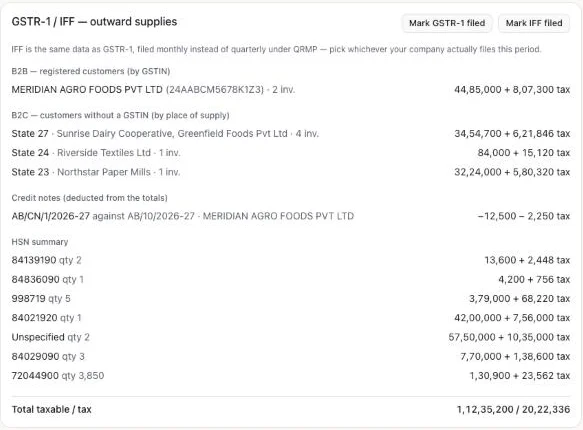 GSTR-1 built from the month's invoices: B2B, B2C by state, credit notes and the HSN summary.
GSTR-2B, IMS and input credit
The CA downloads the month's GSTR-2B from the portal and uploads it. The system matches each line to a recorded supplier bill, and Accounts marks each line accepted or rejected, as on the Invoice Management System, with the reason. Only accepted, matched input credit flows to GSTR-3B. This upload has been tested on a hand-made file in the portal's format, not yet on a real portal download: the first real month is where the column mapping gets confirmed.
GSTR-3B
The net position for the month:
- output tax from invoices and credit notes;
- tax on inward supplies under reverse charge, from supplier bills and transporter freight, in table 3.1(d), and its credit in 4A(3), without counting a bill twice if it is also in an accepted GSTR-2B line;
- accepted input credit;
- the tax payable after credit.
The assistant can take the GST payable figure apart line by line for anyone who asks why it is what it is (see AI answers for finance).
TDS and TCS returns
Accounts → TDS Returns builds the quarterly data files in the formats published by Protean (file formats v1.2, 22 July 2026):
- Form 140 (was 26Q), TDS on payments other than salary, quarters 1 to 4, from supplier bills;
- Form 138 (was 24Q), TDS on salary, quarters 1 to 3, from salary slips. Quarter 4 has no published format yet, so it is a labelled working file for the CA.
A missing PAN, an unused challan or a bill with no mapped section stops the file, with the reason, so a bad file isn't produced. The files haven't been run through the official File Validation Utility (FVU 1.2): the CA runs them through it before upload, as with any file. Nil statements aren't generated.
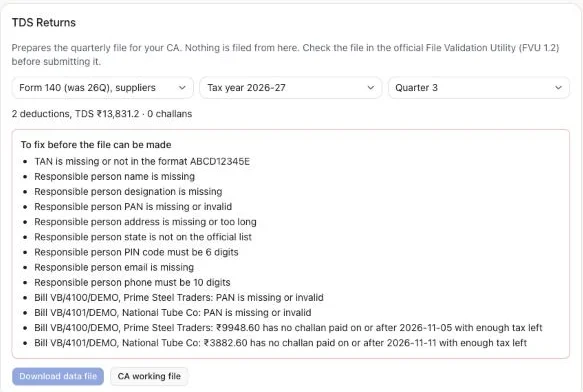 Form 140 for a quarter: the file isn't made until every item in the red box is fixed.
Due dates
Accounts → Compliance lists each filing and deposit (GSTR-1, GSTR-3B monthly or quarterly, TDS and TCS deposits, Forms 138, 140 and 143, PF, ESI and professional tax) as overdue, due soon or upcoming, and the CA or Accounts marks each one done. Holidays and one-off extensions aren't modelled. Where the dates and rates come from is in statutory rates and approvals.
A worked example
The demo company's November GSTR-1 shows B2B supplies of ₹44,85,000 with ₹8,07,300 tax to one registered customer, B2C supplies by state, and a credit note of ₹12,500 with ₹2,250 tax against invoice AB/10. The total taxable value is ₹1,12,35,200 and tax ₹20,22,336, each traced back to its invoice. GSTR-3B then nets that output tax against the input credit accepted from GSTR-2B.
Who does what?
| Step | Accounts | The system | Your CA |
|---|---|---|---|
| GSTR-1 / IFF | Reviews the month | Builds B2B, B2C, credit notes and the HSN summary | Files on the GST portal |
| GSTR-2B | Uploads the portal download; accepts or rejects lines | Matches lines to supplier bills | Advises on rejected lines |
| GSTR-3B | Reviews the net figure | Builds output tax, reverse charge and accepted credit | Files and pays |
| TDS returns | Enters challans and fixes what the file lists | Builds Form 140 and Form 138 data files | Runs the FVU and files |
What it doesn't do yet
- Nothing is filed from the system; there is no GSP or portal connection.
- The GSTR-2B upload and bank import are tested on sample files only.
- TDS files haven't been run through the official FVU 1.2; Form 138 quarter 4 is a working file, and nil statements aren't generated.
- Input tax credit reversal for exempt supplies (rules 42 and 43) is not built.
Common questions
Can an ERP prepare GSTR-1 and GSTR-3B?
Yes, from the issued invoices, credit notes and supplier bills that also post the books, so the return and the ledger agree. The CA files them on the portal.
How does GSTR-2B matching work?
Accounts uploads the month's GSTR-2B from the portal; each line is matched to a recorded supplier bill and marked accepted or rejected, as on the Invoice Management System. Only accepted, matched credit reaches GSTR-3B.
Where does reverse charge show in GSTR-3B?
The tax shows in table 3.1(d) and its credit in 4A(3), from supplier bills and transporter freight, without counting a bill twice if it is also in an accepted GSTR-2B line.
Does the ERP make the TDS return file?
It builds the Form 140 (was 26Q) and Form 138 (was 24Q) data files in Protean's published format, and stops on a missing PAN, an unused challan or an unmapped section. Your CA validates and files them.
Who submits the returns on the portals?
Your CA, on the GST and income-tax portals; the system prepares the data.
Sales, purchase, stores, dispatch, payroll and service in one system, with the books written as the work happens. We build it around your own departments and approvals, and your CA keeps filing on the portals.
A sample company with a login per department, data reset nightly: try the boiler manufacturing demotry the boiler manufacturing demo and sign in as Accounts.
Official sources
- GST portal (returns, GSTR-2B and the Invoice Management System). Goods and Services Tax Network, November 24, 2026.
- TIN and TDS return file formats. Protean eGov Technologies (for the Income Tax Department), November 24, 2026.
What this page is not
A guide written by Ahrom Labs about a system it built. It describes what the software does, checked against the software itself; it has not yet been reviewed by a Chartered Accountant, and rates and rules change. Not tax, legal or accounting advice: your CA decides how your books and returns are kept. Last updated .
Talk to us about your systems.
Tell us what's held together with workarounds right now. We reply to every message ourselves.