Sales invoices and GST: from quotation to receipt
A quotation becomes an invoice. Each line's GST rate is suggested from its HSN code using the official schedule; an unknown code is refused, and a rate that differs from the schedule stops at Issue until a person confirms it. CGST and SGST or IGST follow the customer's state, and the total is rounded to the rupee.
Pujan Motiwala · Written for Indian manufacturers and their CAs · Checked against the system's own finance notes and code on

How does a quotation become an invoice?
Sales converts an accepted quotation into a draft invoice in one step (a quotation worth ₹0 is refused). Lines without an HSN code take it from the product master. A draft can be edited or cancelled; it posts nothing. Sales or Accounts can also raise an invoice with no quotation behind it.
Issue is the step that matters: it checks the invoice, gives it its number and posts the entry. An issued invoice can't go back to draft. From then on it is corrected only by a credit note.
Where does the GST rate come from?
From the HSN code, using the official goods schedule: CBIC Notification 9/2025-Central Tax (Rate), in force from 22 September 2025, with its amendments 19/2025, 01/2026 and 02/2026, plus the service headings a plant and machinery maker bills (construction, professional and technical, repair and installation, job work). The schedule is loaded as dated rows, each with its source, and is used only after the company's own team has approved it (see statutory rates and approvals).
When someone types a line's HSN code, the system looks it up and does one of three things:
- Clear: one rate applies. The GST % is filled in and shown with the schedule entry it came from. Most boiler items land here: boilers, parts, valves, gauges, tubes and plate checked so far are clear at 18%.
- Depends: the same code has different rates for different descriptions (pumps, for example: hand pumps at one rate, others at another). Nothing is filled in; the line shows the candidate rates and their descriptions for a person to choose.
- Default: the code isn't listed in any rate entry, so the schedule's catch-all applies. It's shown as the default, not as a match.
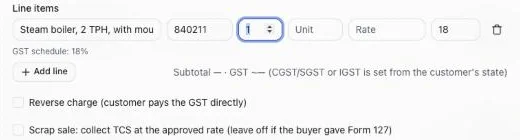 Typing HSN 840211 fills GST 18% and shows where it came from: the hint under the line.
What is checked when the invoice is issued?
- Every line needs an HSN code of the right length. The length follows the company's turnover setting: 6 digits when the company is marked as above ₹5 crore, otherwise 4. Missing codes are asked for in the Issue dialog.
- The code must exist. It is checked against the official list of HSN codes (21,933 of them). A code that isn't on it, such as a made-up 8-digit extension, is refused, and the dialog suggests the nearest real heading.
- The rate must match the schedule. If a line's GST % differs from a clear schedule rate, Issue stops and lists the lines. Nothing is posted until a person confirms, and that confirmation is kept in the audit log. "Depends" and "default" codes are not stopped.
On the demo, a line for a steam boiler with HSN 840211 typed at 12% GST stops at Issue with this message, and the invoice stays a draft until a person answers:
GST % differs from the GST schedule: • Steam boiler, 2 TPH, with mountings (HSN 840211): 12% on the invoice, 18% in the schedule
Issue with the invoice's rates anyway?
These checks run on the server, so they apply however the invoice was made: from a quotation, typed fresh, or from the HSN box.
CGST and SGST, or IGST?
The customer's state decides. If it is the same state as the issuing company's GSTIN, the tax splits equally into CGST and SGST; if not, it is IGST at the full rate. Place of supply comes from the customer's state code. The total is rounded to the nearest rupee after GST (and TCS, for a scrap sale), and the rounding posts to 5700 Round Off; taxable value and GST are not changed by it.
Example: ₹2,45,600.40 taxable at 18%, inter-state. IGST ₹44,208.07, total ₹2,89,808.47, rounded to ₹2,89,808; ₹0.47 is debited to Round Off. The entry is debit Accounts Receivable ₹2,89,808 and Round Off ₹0.47, credit Sales ₹2,45,600.40 and GST Output ₹44,208.07. The general shape of every entry is in how the books post.
What does the invoice PDF show?
It follows CGST Rule 46: supplier and buyer GSTIN, invoice number and date, place of supply with state code, whether tax is payable on reverse charge, HSN, description, quantity, taxable value, the rate and amount of CGST and SGST or IGST, round-off, the amount in words in lakh and crore, and the company's bank details when they are filled in. Once an e-invoice IRN and QR are entered, they print on it too (see e-invoice and e-way bill).
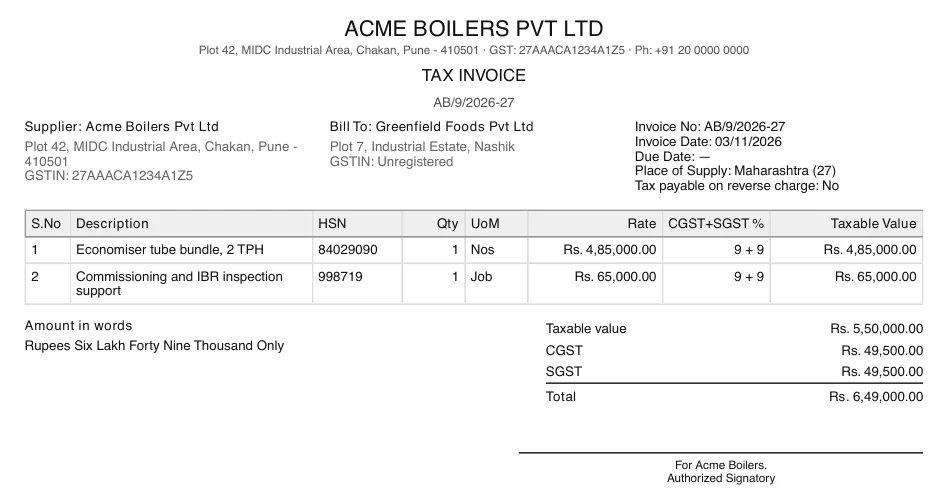 Invoice AB/9/2026-27 from the demo, as the PDF prints it: place of supply, reverse charge, HSN per line, CGST and SGST, and the amount in words in lakh.
Points for your CA to look at: a delivery address different from the billing address isn't stored, the 16-character limit on invoice numbers isn't enforced, and the e-invoice non-applicability declaration and export or SEZ wording aren't printed.
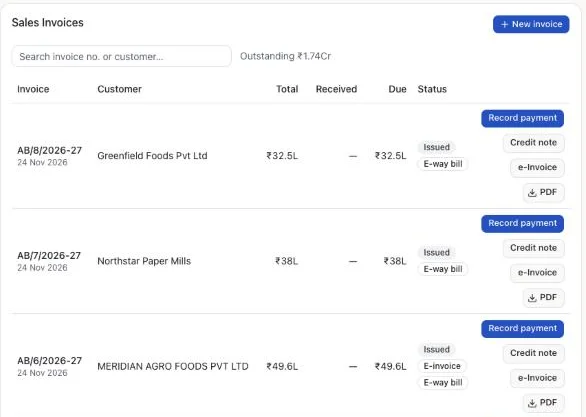 Issued invoices with what is due; the tags show which ones need an e-invoice or an e-way bill.
How are payments recorded?
- Receipts and part payments: Record payment on the invoice. Each receipt debits Bank and credits Accounts Receivable; the invoice shows what is still due and is marked paid when nothing is.
- Order advances: money received against an order before there is an invoice goes to 2800 Customer Advances. When the invoice is issued, the advance settles it.
- Order Tracker and Payment Log: Sales and Accounts see, per order, what was quoted, invoiced, received and still due. A payment logged against an order settles its invoices and holds the rest as an advance.
- Mistakes: a payment logged wrongly or a bounced cheque is reversed by an Accounts Head on its own date, with a reason. The invoices go back to owing and the original stays as history.
"Due" is always worked out one way: invoice total, less money received, less credit notes. Every screen and report uses that one rule.
Credit notes and sales returns
A credit note is raised against an issued invoice and can't exceed what the invoice is worth. It carries GST in the same split as the invoice and reverses Sales, GST Output, any TCS and the round-off in proportion, so a full credit note leaves the invoice at zero. When a return of goods is accepted, the system issues one credit note for it, linked both ways to the return.
Dispatch clearance
Before a boiler leaves, Dispatch needs Accounts' clearance, which shows what the order has been paid against what is due. How freight and the e-way bill work is in dispatch and freight. The month's invoices then feed GSTR-1 and GSTR-3B, described in GST returns.
Who does what?
| Step | You and your team | The system | Your CA |
|---|---|---|---|
| Invoice lines | Sales types the description, HSN, quantity and rate | Suggests the GST % from the HSN code and shows its source | — |
| Issue | Sales or Accounts presses Issue | Checks HSN length and validity and the rate; stops on a mismatch | Advises on a "depends" code or a disputed rate |
| Tax split and round-off | — | CGST and SGST or IGST from the customer's state; rounds to the rupee | Confirms place of supply for unusual deliveries |
| Payments and notes | Accounts records receipts and credit notes | Settles the invoice and posts each step | Reviews credit notes in GSTR-1 |
What it doesn't do yet
- A delivery address different from the billing address is not stored, so place of supply always follows the customer's state code.
- The 16-character invoice number limit isn't enforced, and export or SEZ wording isn't printed; export invoices in foreign currency are not built.
- The e-invoice IRN is entered by a person after generating it on the portal (see e-invoice and e-way bill).
Common questions
How does an ERP decide the GST rate for an HSN code?
It looks the code up in the official goods schedule (Notification 9/2025 and its amendments) loaded as dated rows, and keeps the longest matching code. One rate fills the GST %, several rates show the choices for a person, and an unlisted code falls to the schedule's catch-all and is shown as the default.
What if the HSN code has two possible rates?
The line shows both rates with their schedule descriptions and fills nothing, so a person picks. Pumps are a common example: hand pumps carry one rate and other pumps another.
Can an invoice be issued at a GST rate different from the schedule?
Yes, but only after a person confirms it. Issue stops, lists each line whose rate differs from a clear schedule rate, and records the confirmation in the audit log.
How many HSN digits must an invoice show?
The system asks for 6 digits when the company is marked as above ₹5 crore turnover and 4 otherwise, set per company in Company Entities. Codes are also checked against the official list of 21,933 codes.
How are part payments and advances handled?
Each receipt reduces what the invoice owes until it is paid. Money received against an order before any invoice is held as a customer advance (2800) and settles the invoice when it is issued.
Sales, purchase, stores, dispatch, payroll and service in one system, with the books written as the work happens. We build it around your own departments and approvals, and your CA keeps filing on the portals.
A sample company with a login per department, data reset nightly: try the boiler manufacturing demotry the boiler manufacturing demo and sign in as Accounts.
Official sources
- Central Goods and Services Tax Act, 2017 (updated to 30.09.2020). Central Board of Indirect Taxes and Customs, September 30, 2020.
- CBIC tax information portal (CGST Rules, rule 46; rate notifications). Central Board of Indirect Taxes and Customs, November 24, 2026.
What this page is not
A guide written by Ahrom Labs about a system it built. It describes what the software does, checked against the software itself; it has not yet been reviewed by a Chartered Accountant, and rates and rules change. Not tax, legal or accounting advice: your CA decides how your books and returns are kept. Last updated .
Talk to us about your systems.
Tell us what's held together with workarounds right now. We reply to every message ourselves.