Going live: opening balances, company entities and the CA's first month
Bring in the old books' closing figures as opening balances: each customer's and supplier's open invoices, owned assets with depreciation to date, and one journal for bank, stock, taxes and loans, all against Opening Balance Equity. Match the trial balance to the old books, lock the go-live date, and have your CA review the first month.
Pujan Motiwala · Written for Indian manufacturers and their CAs · Checked against the system's own finance notes and code on

In what order do the opening balances go in?
From Accounts → Opening Balances, in this order:
- Customer and supplier dues: each open invoice and bill from the old books, one by one, with its own date and number. A customer's due posts debit 1100 Accounts Receivable, credit 3200 Opening Balance Equity; a supplier's, debit 3200, credit 2100 Accounts Payable. Receipts, payments, notes, ageing and ledgers then work on them like any other invoice, but they stay out of the sales and purchase registers and the GST returns, because their GST belongs to the old books.
- Assets already owned: Fixed Assets → Already owned, with cost and depreciation to date. Cost goes to 1400, depreciation to 1410 and the difference to 3200; the bank is untouched.
- One journal for the rest: bank balances, stock, GST and TDS balances and staff loans, against 3200. Old staff loans go in this journal, not through HR → Loans, which would pay them out of the bank again.
- Check the trial balance against the old books' closing trial balance. Once every line is in, 3200 holds the net worth the old books ended with.
- Lock the books through the go-live date, so nothing can be posted before it (see month-end and reports).
Entering opening balances is limited to the Accounts Head. There is no bulk upload yet: dues go in one line at a time.
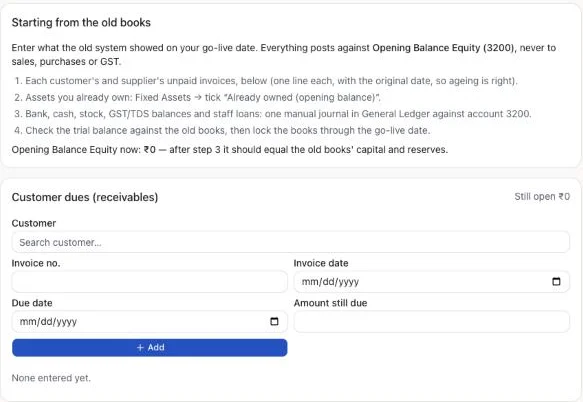 Opening Balances: the go-live steps at the top, then each customer's and supplier's open invoices, one line at a time.
Can one system hold several companies?
Yes. Each company entity has its own GSTIN, registration, letterhead and invoice design, set in Accounts → Company Entities (with a GSTIN lookup), and its own books in the same chart of accounts (see how the books post). The company picked in the top bar narrows the screens and the assistant's answers. Two things are not split by company yet: stock value, because items are shared, and payroll slips. Tell your CA if you run more than one entity.
What about Tally?
A Tally export or sync is not built. Instead, every report downloads as Excel and PDF from the same calculation as the screen, and the CA works from those, as many CAs do with clients who don't use Tally. If your CA must have the books in Tally, say so at the start: it changes the plan. The trade-off in general is in Tally migration.
Why should the CA review the first month?
Because nobody outside Ahrom Labs has yet checked these entries against a real filed return. Every figure has been checked against the system's own rules, on a copy of the demo data, by an automated end-to-end check of the finance flows. That proves the system follows its rules; it doesn't prove the rules match your CA's reading. So for the first month:
- the CA compares GSTR-1 and GSTR-3B from the system with what they would have filed;
- the CA checks TDS, TCS and payroll postings, and the readings marked for the CA throughout these guides (TCS on the GST-inclusive value, the transition month for the PF ceiling, gratuity and additional depreciation conditions);
- you run a real bank file and a real GSTR-2B download through the system, since both have so far been tested only on sample files;
- the statutory rates are approved by your Accounts Head, on the CA's advice (see statutory rates and approvals).
How an implementation runs from start to go-live is in the ERP implementation plan. If you are still choosing a system, start with the finance questions to ask any ERP vendor.
A worked example
On the go-live date the old books show a customer owing ₹6,49,000 on an invoice from October, a supplier owed ₹2,30,000, and a crane bought for ₹16,50,000 with ₹1,22,111 depreciation to date. They go in as:
| Entry | Debit | Credit |
|---|---|---|
| Customer's open invoice | 1100 Accounts Receivable ₹6,49,000 | 3200 Opening Balance Equity ₹6,49,000 |
| Supplier's open bill | 3200 Opening Balance Equity ₹2,30,000 | 2100 Accounts Payable ₹2,30,000 |
| Crane already owned | 1400 Fixed Assets ₹16,50,000 | 1410 Accumulated Depreciation ₹1,22,111 and 3200 ₹15,27,889 |
Bank, stock, tax balances and staff loans follow in one journal against 3200, and the trial balance is checked against the old books.
Who does what?
| Step | You and your team | The system | Your CA |
|---|---|---|---|
| Closing figures | Export the old books' closing trial balance and open items | — | Confirms the closing figures |
| Opening balances | The Accounts Head enters dues, assets and one journal | Posts each against 3200; keeps them out of GST returns | Reviews the opening journal |
| Check and lock | Compare trial balances, lock the go-live date | Refuses postings before go-live | Signs off |
| First month | Run the month normally | Prepares the returns | Reviews GST, TDS, TCS and payroll postings |
What it doesn't do yet
- No bulk upload: opening dues go in one line at a time.
- No Tally export or sync; the CA works from PDF and Excel reports.
- Stock value and payroll slips aren't split by company entity.
Common questions
How do you enter opening balances when moving from Tally?
Take Tally's closing trial balance and open bills on the go-live date, enter each customer's and supplier's open invoice, owned assets and one journal for the rest against Opening Balance Equity, then check the new trial balance matches Tally's. Moving from Tally to an ERP covers what else to migrate.
Do opening invoices appear in GST returns again?
No. They are left out of the sales and purchase registers and GSTR-1, because their GST was reported in the old books.
Can I keep Tally alongside the ERP?
You can keep Tally's past years, but there is no live link from this ERP to Tally; the CA works from the reports. Tally vs a custom ERP compares the options.
How long should a CA review take before relying on it?
One full month: compare the GST returns with what the CA would have filed, check TDS, TCS and payroll postings, and run a real bank file and GSTR-2B through it.
Sales, purchase, stores, dispatch, payroll and service in one system, with the books written as the work happens. We build it around your own departments and approvals, and your CA keeps filing on the portals.
A sample company with a login per department, data reset nightly: try the boiler manufacturing demotry the boiler manufacturing demo and sign in as Accounts.
Official sources
What this page is not
A guide written by Ahrom Labs about a system it built. It describes what the software does, checked against the software itself; it has not yet been reviewed by a Chartered Accountant, and rates and rules change. Not tax, legal or accounting advice: your CA decides how your books and returns are kept. Last updated .
Talk to us about your systems.
Tell us what's held together with workarounds right now. We reply to every message ourselves.