How the books post themselves: one balanced entry per action
In this ERP, nobody types journals for routine work. Issuing an invoice, approving a supplier bill, issuing material or paying salaries each writes its own balanced entry to a fixed chart of accounts. Drafts post nothing, a posted entry is corrected only by a credit note, debit note or reversing journal, and a locked month accepts nothing new.
Pujan Motiwala · Written for Indian manufacturers and their CAs · Checked against the system's own finance notes and code on
Who posts the entries?
Nobody types them. Sales issues an invoice, Procurement records a supplier bill, Stores issues plate to a job, HR pays the month's salaries, and each of those actions writes its own entry to the ledger at the moment it happens. A service engineer's cash and travel post when Accounts settles them (see service and site expenses). Accounts sees the result in the general ledger and the reports, and only types a journal for what no department records, such as a bank charge or the go-live opening balances.
The system keeps three rules on every one of these actions:
- Draft documents post nothing. A quotation, a draft invoice or an unapproved bill can be changed or cancelled freely; the books don't know it exists.
- A posted document is never edited. A wrong invoice is corrected by a credit note, a wrong supplier bill by a debit note, and anything else by a reversing journal. The original and the correction both stay, with who did each and when, in the audit log.
- No money record without its entry. If the entry can't be written (for example because its month is locked), the document isn't saved either. Nothing is left half-done.
What is the chart of accounts?
Every company in the system starts with the same chart, and each account has a fixed code, so reports, the assistant and the CA's working papers all read the same numbers.
| Code | Account | Fed by |
|---|---|---|
| 1001 | Bank & Cash | receipts, payments, salaries, advances, freight, expense claims |
| 1100 | Accounts Receivable | sales invoices, receipts, credit notes, opening customer dues |
| 1200 | Raw Material Inventory | supplier bills, material issues, debit notes |
| 1300 | GST Input Credit | supplier bills, debit notes, freight under reverse charge |
| 1400 / 1410 | Fixed Assets / Accumulated Depreciation | asset purchases, depreciation runs, disposals |
| 1500 | Employee Advances & Loans | staff advances and loans, service cash requests, salary recoveries |
| 2100 | Accounts Payable | supplier bills, payments, debit notes, opening supplier dues |
| 2200 | GST Output Payable | sales invoices, credit notes, reverse charge on purchases |
| 2250 | GST on reverse charge (paid in cash) | freight from a goods transport agency under reverse charge |
| 2300 | TDS Payable | supplier bills, salaries |
| 2350 | TCS Payable | scrap sales |
| 2400 / 2500 / 2600 | PF / ESI / PT Payable | salaries |
| 2800 | Customer Advances | order payments received before an invoice |
| 2900 | Other Payroll Deductions | salary deductions that are not statutory or a recovery |
| 2950 | Expense Claims Payable | approved staff expense claims not yet paid |
| 3200 | Opening Balance Equity | go-live opening balances |
| 4100 | Sales Revenue | sales invoices, credit notes |
| 4200 | Gain/Loss on Asset Disposal | asset disposals |
| 4300 | Interest Income | interest on staff loans |
| 5100 | Material Consumed | material issues, plate and pipe cutting |
| 5200 | Salary Expense | salaries with the employer's PF, ESI and charges |
| 5300 | Depreciation | depreciation runs |
| 5400 | Bank Charges | quick entries from the bank statement |
| 5500 | Freight | freight the company pays |
| 5600 | Travel & Staff Expenses | service travel claims and HR expense claims |
| 5700 | Round Off | rupee rounding on invoices |
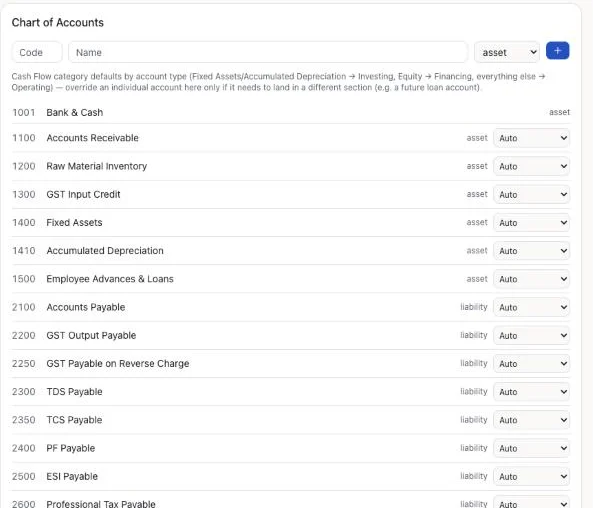 The chart of accounts on the demo: every account has a fixed code and type.
What do the entries look like?
A sales invoice for ₹1,00,000 plus 18% GST to a customer in the same state, issued from Sales:
| Account | Debit | Credit |
|---|---|---|
| 1100 Accounts Receivable | ₹1,18,000 | |
| 4100 Sales Revenue | ₹1,00,000 | |
| 2200 GST Output Payable (CGST ₹9,000 + SGST ₹9,000) | ₹18,000 |
When the customer pays, the receipt moves the balance: debit 1001 Bank ₹1,18,000, credit 1100 Accounts Receivable ₹1,18,000. Sales and GST were already recognised when the invoice was issued, so the receipt doesn't touch them. More on this in sales invoices and GST.
A supplier bill for steel plate of ₹5,00,000 plus 18% GST, recorded against its purchase order and approved:
| Account | Debit | Credit |
|---|---|---|
| 1200 Raw Material Inventory | ₹5,00,000 | |
| 1300 GST Input Credit | ₹90,000 | |
| 2100 Accounts Payable | ₹5,90,000 |
When Stores issues ₹1,20,000 of that plate to a boiler's job, the entry is debit 5100 Material Consumed, credit 1200 Inventory, at the item's average cost. The inventory was debited once, at the bill; the issue only moves it. See stock and job costing and supplier bills and TDS.
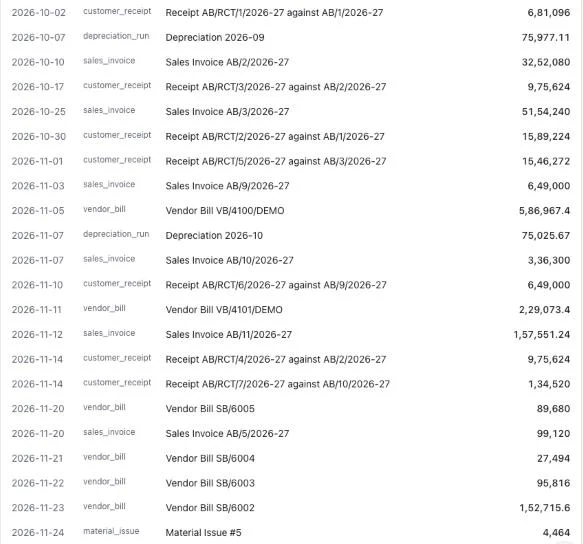 The Journal Register: look at the second column, the department document that wrote each entry (sales invoice, receipt, supplier bill, depreciation, material issue).
Can an entry be posted twice?
No. Each entry is tied to the document that caused it (an invoice, a bill, a packing list's freight), and posting the same document again does nothing. A double click, a retried request or a payment marked twice can't double the books.
How are mistakes corrected?
By a new document, never by changing the old one:
- A wrong or returned sale: a credit note, capped at what the invoice still owes, which reverses sales, GST and any TCS in proportion.
- A wrong or returned purchase: a debit note, which reverses inventory, GST input and the amount owed.
- A payment logged by mistake or a bounced cheque: a payment reversal on its own date, with a reason. The invoices go back to owing.
- Anything else: a manual journal, which is a draft until posted and can be reversed later.
What does the books lock do?
Accounts closes a month by locking it in the general ledger. After that, nothing can be posted with a date inside the locked period: not an invoice, a bill, a salary or a journal. A late document has to be dated in an open month. This is what lets a CA sign off a month and know it won't change underneath them. The month-end steps are in month-end and reports.
Can I see it?
Yes: sign in as Accounts on the boiler manufacturing demoboiler manufacturing demo and open the general ledger, or issue an invoice as Sales and watch its entry appear. Why the books were built into the operations system rather than left to a separate package is in GST, TDS and the general ledger inside a manufacturing ERP.
Who does what?
| Step | You and your team | The system | Your CA |
|---|---|---|---|
| Day-to-day work | Raise invoices, record bills, issue material, run payroll | Writes the balanced entry for each action, once | — |
| Corrections | Raise a credit note, debit note or reversing journal | Posts the correction; keeps the original | Advises which correction fits |
| Bank charges, opening balances | Accounts types a manual journal | Checks it balances before it posts | Reviews the journal |
| Closing a month | Accounts locks the period | Refuses any posting dated inside it | Signs off the locked month |
What it doesn't do yet
- It doesn't import journals from another accounting package; opening balances go in by hand (see going live).
- Stock value and payroll slips are not split by company entity yet, because items and slips are shared across companies.
- Nobody outside Ahrom Labs has yet reviewed the postings against a real filed month; have your CA review the first month.
Common questions
How is GST posted in an ERP?
When a sales invoice is issued, the tax goes to GST Output Payable (2200) and the customer owes the invoice total in Accounts Receivable (1100); when a supplier bill is approved, the GST on it goes to GST Input Credit (1300). Under reverse charge the same tax is posted on both sides. GST returns then read these accounts.
Can a posted entry be edited or deleted?
No. A posted document stays as it is; a credit note, debit note or reversing journal corrects it, and both remain in the books with who did each and when.
What happens if someone posts into a closed month?
The posting is refused. Once Accounts locks a period, every document dated inside it, including invoices, bills, salaries and journals, has to be dated in an open month instead.
Does every department need to learn accounting?
No. Sales, Procurement, Stores, Dispatch, HR and Service do their normal screens; the entry is written for them. Only Accounts works in the general ledger. To test this in another vendor's demo, use the finance questions to ask any ERP vendor.
Can the chart of accounts be changed?
Accounts can add accounts in the general ledger. The fixed codes the system posts to (1001 to 5700) stay, so reports and the assistant read the same numbers in every company.
Sales, purchase, stores, dispatch, payroll and service in one system, with the books written as the work happens. We build it around your own departments and approvals, and your CA keeps filing on the portals.
A sample company with a login per department, data reset nightly: try the boiler manufacturing demotry the boiler manufacturing demo and sign in as Accounts.
Official sources
What this page is not
A guide written by Ahrom Labs about a system it built. It describes what the software does, checked against the software itself; it has not yet been reviewed by a Chartered Accountant, and rates and rules change. Not tax, legal or accounting advice: your CA decides how your books and returns are kept. Last updated .
Talk to us about your systems.
Tell us what's held together with workarounds right now. We reply to every message ourselves.