Payroll and statutory pay: PF, ESI, PT, LWF and TDS on salary
HR runs the month's salary slips. The system tests each wage against the Labour Codes' 50% rule, then works out PF with its pension, insurance and admin parts, ESI, professional tax, labour welfare fund and TDS on salary under either regime. Every rate is a dated row your Accounts Head approves before it changes a slip.
Pujan Motiwala · Written for Indian manufacturers and their CAs · Checked against the system's own finance notes and code on

What does a paid salary slip post?
When HR marks the month's slip as paid, one entry records the whole cost and everything owed:
| Account | Debit | Credit |
|---|---|---|
| 5200 Salary Expense | gross pay + employer's PF, ESI, EDLI, PF admin and LWF | |
| 1001 Bank & Cash | net pay | |
| 2400 PF Payable | employee's and employer's PF, EDLI and admin | |
| 2500 ESI Payable | employee's and employer's ESI | |
| 2600 PT Payable | professional tax | |
| 2300 TDS Payable | TDS on salary | |
| 1500 Employee Advances & Loans | loan EMIs and advance recoveries | |
| 4300 Interest Income | interest on a staff loan | |
| 2900 Other Payroll Deductions | any other deduction, including the employee's LWF |
So the ledger shows the true cost of pay, and each payable shows what must be deposited. The general rules are in how the books post.
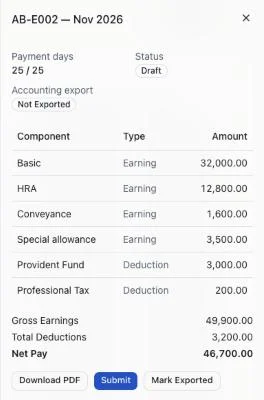 A month's salary slip with its PF and professional tax deductions.
How is the wage for PF and ESI worked out?
Under the Labour Codes, which came into force in November 2025, the wage used for PF and gratuity can't fall below half of total pay. Each month the system tests the slip: basic pay, dearness allowance and retaining allowance count as wage; items such as incentives, performance pay, reimbursements, leave encashment and gratuity are kept outside the test; any other component counts as an allowance. If allowances take more than half, the wage used is raised so it is at least half. HR can set a component's class when adding it. Your CA should confirm how the employer's PF share is treated in the test.
PF, ESI, PT and LWF
- PF: the employee's 12% and the employer's 12%, with the employer's share split into pension (EPS) and provident fund (EPF), plus EDLI and admin charges, on the capped wage. The rate rows carry a ₹25,000 wage ceiling from 17 September 2026 (S.O. 5109(E)); how September's slips use it is for your CA to confirm. Pension stops at 58 and its share goes to EPF. Voluntary PF on full pay is supported.
- ESI: employee and employer shares on the same statutory wage, up to the ESI wage limit in the rate table.
- Professional tax: by the employee's state, including Maharashtra's February ₹300 and its separate band for women. Rows exist for Maharashtra, Gujarat and Telangana; another state is a new data row.
- Labour welfare fund: deducted in the state's months on regular slips.
TDS on salary, both regimes
TDS on salary is worked out on each slip under the new regime (standard deduction only, with the rebate and marginal relief) or the old regime (slabs by age, professional tax, provident fund and declared deductions, capped). Surcharge and 4% cess are included. It covers tax year 2026-27 under the Income-tax Act, 2025 and the Finance Act, 2026; next year needs new rows after the next Finance Act. An exit-month true-up is left to the CA: a final slip computes no TDS. The data for the quarterly TDS return on salary (Form 138, was 24Q) is described in GST returns and TDS files.
Gratuity, bonus and minimum wages
These are in the Statutory Pay Check report, not paid automatically, because a company may use a gratuity fund and declares its own bonus rate:
- Gratuity: last monthly wage × 15/26 × years of service, a part-year over six months counting as a year.
- Bonus: eligibility and the amount between the minimum and maximum rates. The calculation ceiling has a conflict between sources, so the row can't be approved until someone reads the gazette and sets it.
- Minimum wages: a warning per employee by state, zone and skill. It never blocks or changes a slip. Telangana has no row yet.
- PF admin top-up: the month's minimum admin charge for the challan.
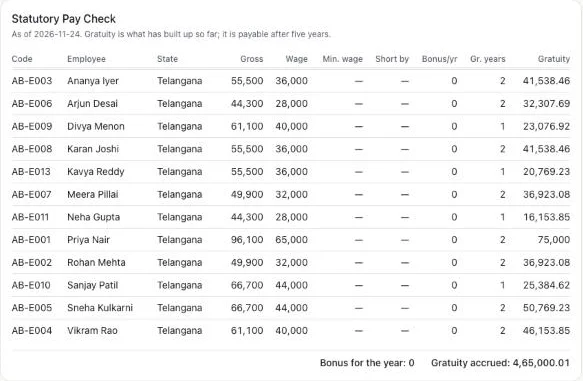 Statutory Pay Check: the wage used for PF beside gross pay, any minimum-wage shortfall, bonus and gratuity built up so far.
Loans, advances and expense claims
- Staff advances and loans are paid from HR → Advances and Loans: debit 1500 Employee Advances, credit Bank. EMIs and recoveries come off the slip; interest on a loan goes to 4300.
- HR expense claims: an approved claim debits 5600 Travel & Staff Expenses; whatever an advance covers comes off 1500, and the rest is owed to the employee in 2950 Expense Claims Payable until it is paid.
Service engineers' cash and travel follow their own approval chain, in service and site expenses.
Who approves the figures?
All of them are dated rows with their source, seeded as proposed. Nothing on a slip changes until the company's Accounts Head approves the row in Accounts → Payroll & Tax Rates; until then the slip works the older way. Some rows (EDLI and admin from July 2026, gratuity, bonus, LWF, two minimum wage rows, two states' PT) are marked "verify" because the official text couldn't be read automatically: the Accounts Head types the source in before approving them. More in statutory rates and approvals.
A worked example
One employee's November slip on the demo: basic ₹32,000, HRA ₹12,800, conveyance ₹1,600 and special allowance ₹3,500, so gross ₹49,900. Basic is more than half of pay, so the wage needs no add-back. PF is 12% of the ₹25,000 ceiling, ₹3,000 from the employee and ₹3,000 from the employer; professional tax is ₹200; gross is above the ESI limit, so there is no ESI. Net pay is ₹46,700. Leaving out EDLI and admin charges for simplicity, the entry is:
| Account | Debit | Credit |
|---|---|---|
| 5200 Salary Expense (gross + employer PF) | ₹52,900 | |
| 1001 Bank & Cash (net pay) | ₹46,700 | |
| 2400 PF Payable (both shares) | ₹6,000 | |
| 2600 PT Payable | ₹200 |
Who does what?
| Step | You and your team | The system | Your CA |
|---|---|---|---|
| Rates | The Accounts Head approves each payroll row | Uses only approved rows; marks rows to verify | Confirms the figures and the readings marked for the CA |
| Monthly slips | HR runs payroll and marks slips paid | Works out the wage, PF, ESI, PT, LWF and TDS; posts the entry | — |
| Gratuity, bonus, minimum wage | HR reads the Statutory Pay Check | Reports them; never pays them automatically | Advises on bonus and gratuity provisions |
| Returns and challans | Accounts deposits PF, ESI, PT and TDS | Lists due dates; builds the Form 138 file | Files them on the portals |
What it doesn't do yet
- Income tax covers tax year 2026-27 only; next year needs new rows after the Finance Act.
- A final (exit) slip computes no TDS; the exit-month true-up stays with your CA.
- Professional tax, LWF and minimum wages have rows for Maharashtra, Gujarat and Telangana only; Telangana has no minimum wage row yet.
- The bonus calculation ceiling has conflicting sources and can't be approved until someone reads the gazette.
Common questions
How does an ERP apply the Labour Codes' 50% wage rule?
It adds up the slip's components each month: basic, dearness allowance and retaining allowance count as wages, and allowances are tested against half of total pay. Under the Code on Social Security, any amount by which those exclusions pass one-half is added back to wages, and that wage drives PF and gratuity.
What is the PF wage ceiling in the payroll?
The rate rows carry a ₹25,000 ceiling from 17 September 2026 (S.O. 5109(E)); how September's slips use it is for your CA to confirm.
How is gratuity worked out for monthly-paid staff?
Fifteen days' wages for each completed year (a part-year over six months counts as a year), where fifteen days' wages for a monthly-paid employee is the last monthly wage divided by 26 and multiplied by 15, as the Code on Social Security says. The system reports it in the Statutory Pay Check; it doesn't pay it.
Does the payroll handle both income-tax regimes?
Yes, for tax year 2026-27: the new regime with the standard deduction, rebate and marginal relief, and the old regime with slabs by age, professional tax, provident fund and declared deductions.
Can a salary advance be recovered through payroll?
Yes. Advances and loan EMIs come off the slip and reduce Employee Advances (1500); interest on a staff loan goes to Interest Income (4300).
Quoted from the official texts (3)
“exceeds one-half, or such other per cent. as may be notified by the Central Government, of the all remuneration calculated under this clause, the amount which exceeds such one-half, or the per cent. so notified, shall be deemed as remuneration and shall be accordingly added in wages under this clause”
Code on Social Security, 2020, section 2(88), first proviso (the 50% wage rule)
“employer shall pay gratuity to an employee at the rate of fifteen days' wages”
Code on Social Security, 2020, section 53(2) (gratuity)
“the fifteen days' wages shall be calculated by dividing the monthly rate of wages last drawn by him by twenty-six and multiplying the quotient by fifteen.”
Code on Social Security, 2020, section 53, Explanation 3 (monthly-rated employees)
Sales, purchase, stores, dispatch, payroll and service in one system, with the books written as the work happens. We build it around your own departments and approvals, and your CA keeps filing on the portals.
A sample company with a login per department, data reset nightly: try the boiler manufacturing demotry the boiler manufacturing demo and sign in as Accounts.
Official sources
- The Code on Social Security, 2020 (36 of 2020). Ministry of Law and Justice, Gazette of India, September 29, 2020.
- Employees' Provident Fund Organisation. Ministry of Labour and Employment, November 24, 2026.
- Employees' State Insurance Corporation. Ministry of Labour and Employment, November 24, 2026.
What this page is not
A guide written by Ahrom Labs about a system it built. It describes what the software does, checked against the software itself; it has not yet been reviewed by a Chartered Accountant, and rates and rules change. Not tax, legal or accounting advice: your CA decides how your books and returns are kept. Last updated .
Talk to us about your systems.
Tell us what's held together with workarounds right now. We reply to every message ourselves.