Stock value, material issues, cutting and scrap sales with TCS
Stock is valued at weighted average cost, set by approved supplier bills. Issuing or cutting material for a job moves that cost from inventory to material consumed; usable offcuts go back into stock by weight. Scrap is sold on a sales invoice marked as a scrap sale, which adds TCS at the rate your Accounts Head approved.
Pujan Motiwala · Written for Indian manufacturers and their CAs · Checked against the system's own finance notes and code on
How is stock valued?
At weighted average cost. Each approved supplier bill adds its quantity and value to the item (the bill debits 1200 Raw Material Inventory, see supplier bills and TDS), and the item's average cost is recalculated. A debit note for a short or rejected supply takes the value back out. Nobody keys a rate into Stores: the value comes from what was actually billed.
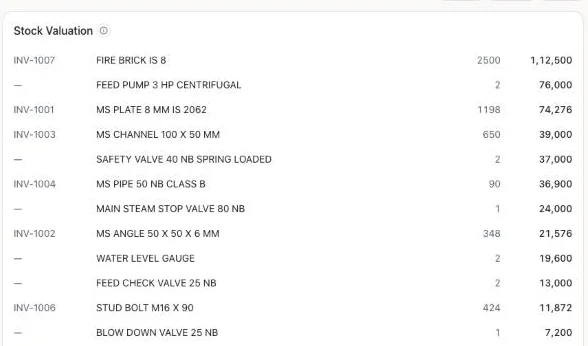 Stock Valuation: each item's quantity and value at average cost, with PDF, Excel and CSV buttons.
What happens when Stores issues material?
The issue moves the value, it doesn't create it. Issuing plate, tube or fittings to a boiler's job posts:
| Account | Debit | Credit |
|---|---|---|
| 5100 Material Consumed | quantity × average cost | |
| 1200 Raw Material Inventory | quantity × average cost |
The inventory was debited once, when the bill was approved, so an issue never debits it a second time. The rules every entry follows are in how the books post.
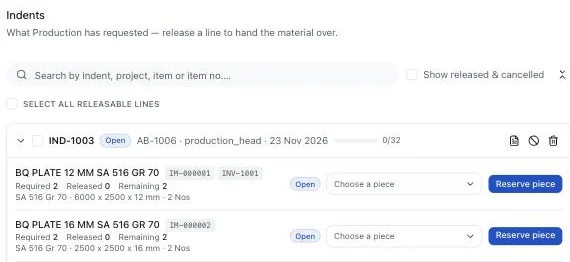 Production's indent in Stores: each line is released against a chosen piece of plate, and releasing it hands the material over for the job.
How are plate and pipe cutting costed?
A plate or pipe is often cut, not issued whole. Stores records the cut: the part used for the job is charged to Material Consumed, the usable offcut goes back into stock as its own piece with its weight worked out from its shape, and the rest is scrap. Weight is conserved exactly: in one recorded cut, a 157.00 kg plate became 127.17 kg used, 15.70 kg remnant and 14.13 kg scrap. How offcuts keep their traceability is in plate remnants back into stock.
How is scrap sold, and what about TCS?
Scrap (cut-offs, rejected steel) is sold on an ordinary sales invoice with Scrap sale ticked on New Invoice. The seller of scrap collects tax at source: the Income-tax Act, 2025 lists "Sale of scrap" in the TCS table of section 394(1). The system:
- charges TCS only from a TCS rate that the company's Accounts Head has approved; with no approved rate it charges none;
- uses the rate in force on the invoice date, since rates are dated rows (the rows carry 1% for earlier invoices and 2% from 1 April 2026, citing the Finance Act, 2026; your CA confirms them before approval);
- works TCS out on the invoice value including GST, a reading your CA should confirm;
- posts it to 2350 TCS Payable and prints the TCS line on the invoice PDF;
- reverses the TCS on the credited part when a credit note is raised.
Example, at an approved 2%: scrap of ₹1,00,000 plus 18% GST. TCS is ₹2,360 and the total ₹1,20,360. The entry is debit Accounts Receivable ₹1,20,360; credit Sales ₹1,00,000, GST Output ₹18,000 and TCS Payable ₹2,360. When the customer pays in full, receivables clear and the books balance. More on invoices in sales invoices and GST.
Limits today: TCS can't be added when an invoice is made from a quotation (raise the scrap invoice directly), and TCS deposits and returns are handled with the CA, as described in GST returns and TDS files.
Which stock reports are there?
Stock Valuation (quantity and value per item at average cost), Stock Ledger (every receipt and issue of an item) and Stock Movement, each on screen and as PDF and Excel. Stock value is not split by company entity yet, because items are shared across companies; your CA should know this if you run more than one entity (see going live).
A worked example
Stores issues 500 kg of 8 mm plate to a boiler's job. The plate's average cost from its approved bills is ₹62 a kg, so the issue is worth ₹31,000:
| Account | Debit | Credit |
|---|---|---|
| 5100 Material Consumed | ₹31,000 | |
| 1200 Raw Material Inventory | ₹31,000 |
If 40 kg of that plate comes back as a usable offcut, it returns to stock as its own piece at the same cost per kg.
Who does what?
| Step | You and your team | The system | Your CA |
|---|---|---|---|
| Stock value | Procurement records bills | Recalculates each item's average cost from approved bills | — |
| Issue and cutting | Stores releases material and records cuts | Costs the issue and posts material consumed | — |
| Scrap sale | Sales ticks "Scrap sale" on the invoice | Adds TCS at the approved rate and posts it | Confirms the rate and that TCS applies on the GST-inclusive value |
| Stock reports | — | Stock valuation, ledger and movement in PDF and Excel | Uses them for the closing stock |
What it doesn't do yet
- TCS can't be added when an invoice is made from a quotation; raise the scrap invoice directly.
- Stock value is not split by company entity, because items are shared.
- TCS deposits and the TCS return are handled with your CA.
Common questions
How does an ERP value raw material stock?
At weighted average cost: each approved supplier bill adds its quantity and value, and the item's average cost is recalculated. Issues are costed at that average.
Is material issue a second purchase entry?
No. The inventory was debited once, when the bill was approved; an issue only moves that value from inventory to material consumed.
Is TCS charged on scrap sales?
The Income-tax Act, 2025 lists sale of scrap in its TCS table. The system charges TCS only from a rate your Accounts Head has approved, dated by the invoice date.
What happens to plate offcuts?
A usable offcut goes back into stock as its own piece, with its weight worked out from its shape; the rest is recorded as scrap.
Quoted from the official texts (1)
“Sale of scrap.”
Income-tax Act, 2025, section 394(1), Table, serial 4
Sales, purchase, stores, dispatch, payroll and service in one system, with the books written as the work happens. We build it around your own departments and approvals, and your CA keeps filing on the portals.
A sample company with a login per department, data reset nightly: try the boiler manufacturing demotry the boiler manufacturing demo and sign in as Accounts.
Official sources
- Income-tax Act, 2025 (30 of 2025). Ministry of Law and Justice, Gazette of India, August 22, 2025.
What this page is not
A guide written by Ahrom Labs about a system it built. It describes what the software does, checked against the software itself; it has not yet been reviewed by a Chartered Accountant, and rates and rules change. Not tax, legal or accounting advice: your CA decides how your books and returns are kept. Last updated .
Talk to us about your systems.
Tell us what's held together with workarounds right now. We reply to every message ourselves.