The ASME PP stamp: pressure piping certification
PP stands for Pressure Piping. It is ASME's Section I Certificate of Authorization for fabricating and assembling the pressure piping of a power boiler, mainly boiler external piping, whose technical rules come from B31.1. The certificate is valid for three years, needs an inspection agreement with an Authorized Inspection Agency, and costs $4,500 plus an $11,000 advance deposit. A shop that already holds the S certificate can add PP without another full joint review.
Pujan Motiwala · Written to the ASME BPVC 2025 Edition · checked against ASME's and the National Board's public pages on
Video chapters (10)
- 0:00ASME Section I PP Stamp Overview (BEP, B31.1 & Fees)
- 0:21What Piping PP Covers: Boiler External Piping Valve Boundary
- 0:40How PP Fits Beside S, A, U & National Board R (2013 Mark Update)
- 1:02What a Shop Needs: AIA, Piping QC Manual, Sec IX, Demo & Books
- 1:24PP Stamp Fees ($4,500 + $11K) & S-Holder Add-On Shortcut
- 1:47Worked Main Steam Spool: MTRs, Welds, B31.1 NDE & Forms P-4A / P-4B
- 2:10Six ASME Primary Sources & Ten Verified Quotes
- 2:30Per-Job Spool Dossiers, Per-Shop Files & Spool-by-Spool ERP Logs
- 2:492025 Edition & Authorized Inspector Verification Notice
- 3:00Next Steps: Authorized Inspector, B31.1 vs. B31.3 & QC Manual (S20)
What does the ASME PP stamp mean?
PP stands for Pressure Piping. ASME lists it among the power boiler certificates under Section I of the Boiler and Pressure Vessel Code, as "PP - Pressure Piping", beside S (power boilers), A (assembly of power boilers), E (electric boilers) and M (miniature boilers). A shop that holds it is authorized to fabricate and assemble the pressure piping that Section I covers and to apply the ASME Certification Mark with the PP designator to that piping.
"Stamp" is the everyday word. ASME's FAQ records that "The old Code Symbol Stamps for ASME BPVC Sections I, IV, VIII, X, and XII (U, S, PP, etc.) were discontinued on January 31, 2013." Since then there is one Certification Mark, and PP is the designator placed with it. See ASME stamps for the full list.
What piping does the PP stamp cover?
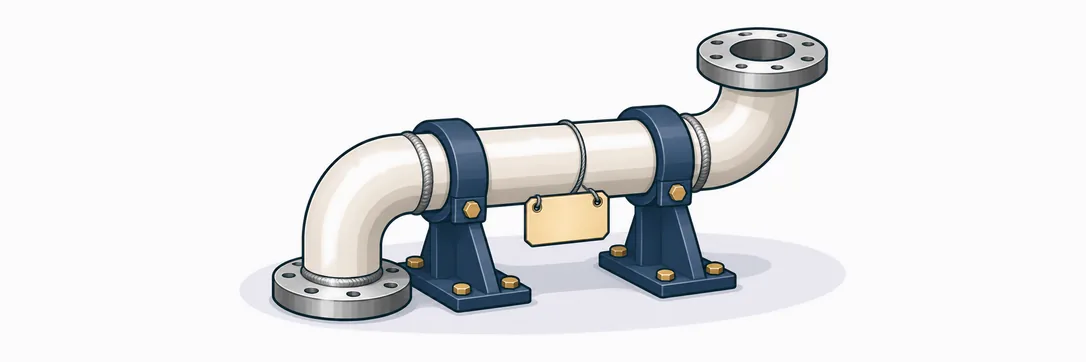
Mainly boiler external piping: the piping that runs from the boiler proper out to the valve or valves that Section I requires, such as the main steam line to its stop valve, the feedwater line back to its stop and check valves, and the blowoff and drain lines to their valves. Section I holds the administrative control over this piping (who may build it, inspection, stamping and the data report), and the technical rules for materials, design, fabrication and testing come from B31.1 Power Piping.
Piping beyond those valves is non-boiler external piping. It is built to B31.1 (or B31.3 in a process plant) and doesn't need a PP certificate under the ASME Code, although the owner, the insurer or the state may set their own requirements for who can weld it.
What is the difference between the PP, S and A stamps?
| Certificate | Covers | Typical holder |
|---|---|---|
| S | Power boilers, and their parts and piping | Boiler manufacturers |
| PP | Pressure piping for power boilers | Pipe fabrication shops and mechanical contractors |
| A | Assembly of power boilers in the field | Erectors and installers |
| U | Pressure vessels under Section VIII Division 1 | Vessel shops |
A boiler manufacturer with the S certificate can build the boiler's external piping under it. A piping fabricator or mechanical contractor who doesn't build boilers holds PP alone. Many shops hold PP together with U and the National Board R certificate, because power plant and industrial customers ask for all three.
What does a shop need to get the PP stamp?
The same route as the other boiler certificates: an application to ASME, a written quality control system, the code books, an inspection agreement and a joint review of the shop.
- Inspection agreement. ASME's handbook says "the Applicant must have an inspection agreement in place with an ASME Accredited Authorized Inspection Agency (AIA)", and its table of certificates lists PP as valid for 3 years with the agreement required. See Authorized Inspector.
- Quality control manual describing how the shop controls drawings, materials, welding, examination, heat treatment, calibration and records for piping. See the QC manual.
- Code books. ASME lists PP and S together ("Pressure Piping and Power Boilers"): Section I, Section II Parts A, B, C and D, Section V, Section IX, B31.1 Power Piping and CA-1.
- Welding qualifications to Section IX: procedures, welders and their continuity. See WPS, PQR and WPQ.
- A demonstration piece for the joint review, so the team can see the system working on real piping.
How much does the PP stamp cost?
ASME's price guide: "All other Certificates: $4,500.00 per certificate and Advance Deposit: $11,000.00", and "Certification Mark: $400.00 per stamp plus applicable tax and shipping". The deposit goes toward the cost of the review. On top of that come the Authorized Inspection Agency's contract, the code books, and the time to write the manual and qualify welding procedures. The certificate is renewed every three years with another review.
Can an S stamp holder add PP without another review?
Yes. ASME's FAQ says "A full ASME Joint Review is not required for: A holder of an ASME S Certificate who applies for an additional A or PP Certificate(s) of Authorization." ASME asks the team leader of the last review and the shop's inspection agency to confirm in writing that the QC manual and system now cover the added work, and issues the certificate once the fees are received. A shop that holds only U needs a joint review to add PP.
Which data report goes with PP piping?
ASME's Section I forms include P-4A, the "Manufacturers' Data Report for Fabricated Piping", and P-4B, the "Manufacturers' Data Report for Field Installed Mechanically Assembled Piping". The fabricator completes the report for the piping it built, the Authorized Inspector signs it, and it goes to the boiler manufacturer or assembler to join the boiler's own data reports. The piping carries the Certification Mark with the PP designator, on the pipe or on a nameplate, as Section I allows for the size.
Can you show a PP job from order to data report?
A made-up example: a fabricator receives an order for the main steam spool between a watertube boiler's outlet and its stop valve.
- Contract review. Confirm the piping is boiler external piping, the code edition, and who will file the report.
- Materials. Pipe, fittings and flanges are received against their MTRs and marked with heat numbers.
- Welding. Each joint is welded to a qualified procedure by a qualified welder, with the welder's identity recorded per joint.
- Examination and heat treatment as B31.1 requires for the material and thickness; see PWHT.
- Hold points. The Authorized Inspector is notified at the points on the inspection and test plan.
- Pressure test, witnessed where required; see hydrostatic test.
- Stamping and report. The mark is applied and the P-4A is signed by the shop and the Inspector.
What records should a PP shop keep?
Per job: the purchase order and code edition, drawings and revisions, MTRs by heat number, a weld map with the procedure and welder for each joint, examination and heat treatment reports, the pressure test record, any nonconformance reports and the signed data report. Per shop: the QC manual, welder qualifications and continuity, calibration records, the inspection agreement, and the certificate's expiry date.
Our US boiler demo keeps the same chain for vessels and boilers: material by heat number, welds by procedure and welder, hold points, NCRs and the data book. Spool-by-spool piping records are something we would build for a piping fabricator. See ERP for boiler and pressure vessel shops.
Quoted from the official text (10)
“PP - Pressure Piping”
ASME, Boiler and Pressure Vessel Certification page, Power Boilers list
“PP- Pressure Piping 3 Yes”
ASME BPV-GUI-03, Exhibit A (certificate, years valid, AIA agreement required)
“the Applicant must have an inspection agreement in place with an ASME Accredited Authorized Inspection Agency (AIA)”
ASME BPV-GUI-03, application requirements
“A full ASME Joint Review is not required for: A holder of an ASME S Certificate who applies for an additional A or PP Certificate(s) of Authorization.”
ASME Certification FAQ
“The old Code Symbol Stamps for ASME BPVC Sections I, IV, VIII, X, and XII (U, S, PP, etc.) were discontinued on January 31, 2013.”
ASME Certification FAQ
“Pressure Piping and Power Boilers”
ASME, Required Code Books page, PP & S Certification
“All other Certificates: $4,500.00 per certificate and Advance Deposit: $11,000.00”
ASME, Price Guide for Certifications
“Certification Mark: $400.00 per stamp plus applicable tax and shipping”
ASME, Price Guide for Certifications
“Manufacturers' Data Report for Fabricated Piping”
ASME, Data Report Forms page, Section I forms
“Manufacturers' Data Report for Field Installed Mechanically Assembled Piping”
ASME, Data Report Forms page, Section I forms
WPS and PQR registers, welder continuity, heat numbers from receipt to nameplate, and the data report package: the records a Code shop keeps, in one system.
A boiler manufacturer's system, from enquiry to dispatch and the IBR folder, with sample logins: try the live demo.
A boiler and pressure vessel shop's system, from inquiry to shipping and the ASME data report package, with sample logins: try the live demo. Fixed price, scope agreed before work starts: see the prices.
Official sources
- Boiler and Pressure Vessel Certification. ASME, November 1, 2026.
- Boiler and Pressure Vessel Certificates of Authorization and the Certification Mark: Informational Handbook (BPV-GUI-03). ASME, May 12, 2023.
- Frequently Asked Questions (Certification and Accreditation). ASME, November 5, 2026.
- Required Code Books. ASME, November 5, 2026.
- Price Guide for Certifications. ASME, November 5, 2026.
- ASME Data Report Forms. ASME, November 5, 2026.
What this page is not
A guide written by Ahrom Labs, not engineering advice, and not yet reviewed by an Authorized Inspector. The ASME Code is copyrighted and sold by ASME: paragraphs are cited by number and explained in our own words, never reproduced. Check every figure against your copy of the 2025 Edition and with your Authorized Inspector before relying on it. Last updated .
Talk to us about your systems.
Tell us what's held together with workarounds right now. We reply to every message ourselves.