Dispatch and freight: posting freight, GST on transport, registers
When the company pays for transport, Dispatch posts the freight from the packing list, once only, as no GST, transporter under forward charge, or under reverse charge. Reverse-charge GST is owed in cash, claimed back as input credit and shown in GSTR-3B. Goods leave only after Accounts clears the order's payments.
Pujan Motiwala · Written for Indian manufacturers and their CAs · Checked against the system's own finance notes and code on
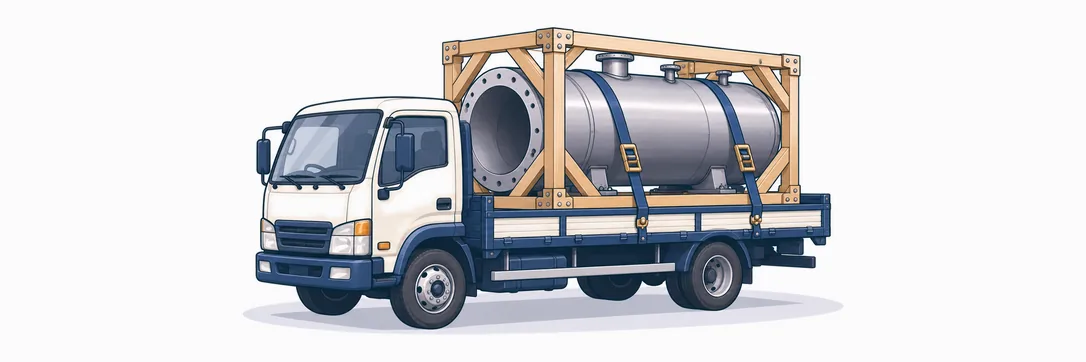
Who can send a boiler out?
Dispatch prepares the packing list and links the sales invoice to it, but the goods leave only after Dispatch Clearance from Accounts, which shows what the order has been paid against what is due. Payment terms are checked by a person with the figures in front of them, not remembered. How invoices and receipts work is in sales invoices and GST.
How is freight posted?
Only when the company itself bears the freight (Packing list → Post freight). Freight the customer pays the transporter directly posts nothing. Posting is tied to the packing list, so posting it twice does nothing: one packing list, one freight entry.
The person picks how GST applies to the transporter's charge:
| Treatment | Entry |
|---|---|
| No GST | Debit 5500 Freight, credit 1001 Bank |
| Goods transport agency, forward charge | Debit 5500 Freight and 1300 GST Input Credit, credit 1001 Bank for freight plus GST |
| Goods transport agency, reverse charge | Debit 5500 Freight and 1300 GST Input Credit; credit 1001 Bank for the freight and 2250 GST on reverse charge for the tax |
Under reverse charge the company, not the transporter, pays the GST, in cash: input tax credit can't be used to settle it, which is why it has its own account, 2250. The same amount is claimed back as input credit. In GSTR-3B the tax shows in table 3.1(d) and its credit in 4A(3), without counting it again if the same bill is already in an accepted GSTR-2B line.
Rates. The forward-charge rate is from Notification 15/2025-Central Tax (Rate). The reverse-charge rate is held as a draft to verify against the official notifications, and freight posting with a rate is refused until an Accounts Head approves that rate (see statutory rates and approvals). TDS is not deducted on this freight route; a transporter billed through a supplier bill follows supplier bills and TDS instead.
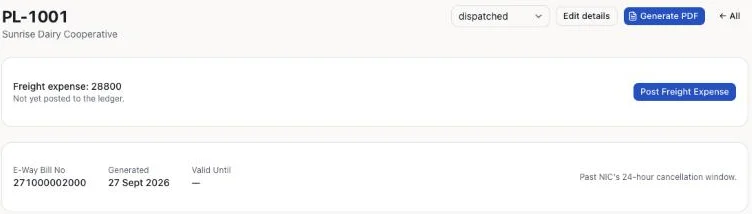 Packing list PL-1001: the freight is posted from here, once, and the e-way bill number is kept with it.
What about the e-way bill?
The e-way bill for a consignment is prepared, recorded and cancelled from the packing list, and its number is stored with the packing list. The live connection to the government's NIC system is built but has never run: it needs the company's own NIC access. Until then, the e-way bill is generated on the government portal and its number recorded here. Details in e-invoice and e-way bill.
Which registers are there?
The dispatch register, the e-way bill register and the freight register, each on screen and as PDF and Excel, in Dispatch and in Accounts. Freight paid also appears in the general ledger under 5500 and in the profit and loss.
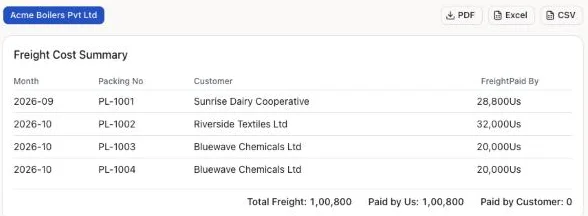 Freight Cost Summary: freight by packing list, split between what the company paid and what the customer paid.
A worked example
A packing list's transporter charges ₹20,000. With no GST, posting it from the packing list debits 5500 Freight and credits Bank ₹20,000. If the transporter is a goods transport agency under reverse charge and your Accounts Head has approved, say, a 5% rate, the GST of ₹1,000 is added:
| Account | Debit | Credit |
|---|---|---|
| 5500 Freight | ₹20,000 | |
| 1300 GST Input Credit | ₹1,000 | |
| 1001 Bank & Cash | ₹20,000 | |
| 2250 GST on reverse charge | ₹1,000 |
Who does what?
| Step | You and your team | The system | Your CA |
|---|---|---|---|
| Clearance | Accounts clears the order | Shows what is paid against what is due | — |
| Freight | Dispatch posts it from the packing list and picks the GST treatment | Posts once; refuses a GST treatment without an approved rate | Confirms the reverse-charge rate |
| e-Way bill | Generates it on the portal and records the number | Stores it with the packing list | — |
| Registers | — | Dispatch, e-way bill and freight registers | Reads them for GSTR-3B |
What it doesn't do yet
- The reverse-charge rate for transporter freight is a draft until verified against the official notifications.
- TDS isn't deducted on freight posted from a packing list.
- The e-way bill isn't generated live; it needs the company's NIC access.
Common questions
Who pays GST on freight to a transporter?
Under reverse charge, the company receiving the service pays it, in cash, and can usually claim it back as input credit; under forward charge, the transporter charges it on the bill. Dispatch picks which applies.
Can freight be posted twice for the same packing list?
No. Freight is tied to the packing list, so posting it again does nothing.
Is freight paid by the customer recorded?
It posts nothing, because the company didn't pay it. The freight summary shows it as paid by the customer.
Can a boiler leave before payment?
Not without Accounts' clearance, which shows the order's payments against what is due.
Sales, purchase, stores, dispatch, payroll and service in one system, with the books written as the work happens. We build it around your own departments and approvals, and your CA keeps filing on the portals.
A sample company with a login per department, data reset nightly: try the boiler manufacturing demotry the boiler manufacturing demo and sign in as Accounts.
Official sources
- CBIC tax information portal (GST rate notifications for goods transport agency services). Central Board of Indirect Taxes and Customs, November 24, 2026.
- e-Way Bill System. National Informatics Centre, November 24, 2026.
What this page is not
A guide written by Ahrom Labs about a system it built. It describes what the software does, checked against the software itself; it has not yet been reviewed by a Chartered Accountant, and rates and rules change. Not tax, legal or accounting advice: your CA decides how your books and returns are kept. Last updated .
Talk to us about your systems.
Tell us what's held together with workarounds right now. We reply to every message ourselves.