Supplier bills and TDS under the Income-tax Act, 2025
A supplier bill is recorded against its purchase order. TDS under section 393 of the Income-tax Act, 2025 is taken on the value before GST, at the rate for the nature of payment, and the system adds up each supplier's bills in the tax year so the single-bill and yearly limits apply. Duplicate bill numbers are refused.
Pujan Motiwala · Written for Indian manufacturers and their CAs · Checked against the system's own finance notes and code on

How does a supplier bill get into the books?
Procurement records the bill against an issued purchase order (PO → Record Bill). The bill can only reach a supplier through a PO, so every bill can be traced to what was ordered. A bill number the same supplier has already used is refused. The bill is a draft until it is approved; approval posts the entry:
| Account | Debit | Credit |
|---|---|---|
| 1200 Raw Material Inventory | bill value before GST | |
| 1300 GST Input Credit | GST on the bill | |
| 2100 Accounts Payable | bill total less TDS | |
| 2300 TDS Payable | TDS deducted |
The value added to inventory sets the item's average cost, which Stores then issues at (see stock and job costing). Payment then debits Accounts Payable and credits Bank. A short or wrong supply is corrected with a debit note carrying GST, which reduces inventory, GST input and the amount owed; an accepted purchase return issues one debit note for it. The general rules are in how the books post.
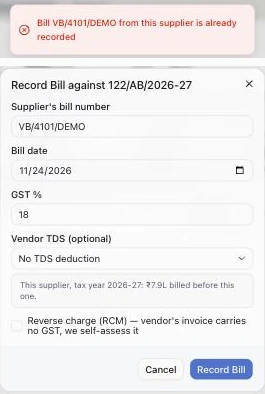 Entering a bill number this supplier has already billed: the bill is refused and nothing is saved.
How is TDS worked out?
Since 1 April 2026, TDS on payments to residents sits in section 393 of the Income-tax Act, 2025. Serial 6 of its table covers "Payments to contractors, fees for professional and technical services, etc." (quoted below). On Record Bill, the person picks the nature of payment, and the system:
- takes TDS on the value before GST, not on the invoice total;
- reads the rate for that section from the company's approved rate table;
- adds up the supplier's bills of the same nature in the tax year, so the yearly limit is applied, not only the single-bill one;
- when a bill crosses the yearly limit, also taxes the earlier bills that were under it and had nothing deducted, and shows the year-to-date total on the bill form.
For contractors (serial 6(i)) the Act sets the limits at ₹30,000 for a single sum and ₹1,00,000 for the year's total. Other limits held in the system are professional fees (₹50,000), commission (₹20,000) and rent (₹50,000 a month); these six limits are kept as draft rows for the client's CA to confirm. Rates and thresholds for contractors are explained, with the Act quoted, in TDS on payments to contractors.
Example: a job-work contractor (a company) bills ₹40,000 plus 18% GST. The bill is above the ₹30,000 single-sum limit, so TDS at 2% is ₹800 on the ₹40,000 (not on the GST). The entry is debit Inventory ₹40,000 and GST Input ₹7,200, credit Accounts Payable ₹46,400 and TDS Payable ₹800.
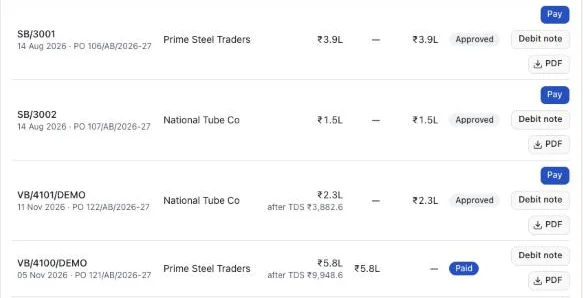 Each bill sits against its purchase order; the line under the total shows the amount after TDS.
Technical fees or professional fees?
They are different rates. In serial 6(iii), fees for technical services (other than professional services) are at 2%, and other cases, including professional fees, at 10%. The system keeps them apart as D(a) technical at 2% and D(b) professional at 10%. A bill recorded before this was split keeps the section it was recorded with; such a bill stops the TDS return file until a person corrects it, so the error can't reach the return.
Other cases the system handles
- Goods above ₹50 lakh: a warning, with tax on the excess only, for the CA to confirm whether the buyer's turnover test applies.
- Transporters: the transporter's declaration is recorded on the bill.
- Reverse charge on purchases: where the supplier doesn't charge GST and the company pays it, the GST is posted both as input credit and as output tax.
- Purchase Register and open PO ageing reports list the bills and what is still to be billed.
TDS deducted is deposited and reported in the quarterly return: the system builds the Form 140 data file (Form 26Q before), described in GST returns and TDS files. Where the rates come from, and who approves them, is in statutory rates and approvals.
Who does what?
| Step | You and your team | The system | Your CA |
|---|---|---|---|
| Bill entry | Procurement records the bill against its PO and picks the nature of payment | Refuses a duplicate number; shows the supplier's year-to-date total | — |
| TDS | — | Works out TDS on the value before GST, applying single-bill and yearly limits | Confirms the section and the draft limits |
| Approval and payment | Accounts approves and pays | Posts the bill and the payment | — |
| TDS return | Accounts generates the Form 140 file | Stops the file on a missing PAN, challan or section | Validates with the FVU and files |
What it doesn't do yet
- The six TDS limits are kept as draft rows until your CA confirms them.
- For goods above ₹50 lakh, the buyer's turnover test is left to your CA; the system only warns and taxes the excess.
- TDS deposits (challans) are entered by hand from the bank; the system doesn't pay them.
Common questions
Is TDS deducted on the GST amount?
No. TDS is worked out on the bill's value before GST, and GST is posted separately to GST Input Credit.
What happens when a supplier crosses the ₹1,00,000 yearly limit?
TDS applies to the bill that crosses it and also to that supplier's earlier bills in the year that had nothing deducted, so the year's total is taxed as the limit requires.
What is the TDS rate for technical fees versus professional fees?
Under serial 6(iii) of section 393's table, fees for technical services are at 2% and other cases, including professional fees, at 10%. The system keeps them as two separate sections so they can't be mixed up.
Can the same supplier bill be entered twice?
No. A bill number the same supplier has already billed is refused before anything is saved.
Where does section 194C go under the new Act?
Contractor TDS moved from section 194C of the 1961 Act to section 393(1), Table serial 6, of the Income-tax Act, 2025, from 1 April 2026. TDS on payments to contractors explains it with the Act quoted.
Quoted from the official texts (4)
“Payments to contractors, fees for professional and technical services, etc.”
Income-tax Act, 2025, section 393(1), Table, serial 6 (heading)
“(a) ₹ 30000; for any such sum; and (b) ₹ 100000 in case of aggregate of such sums.”
Income-tax Act, 2025, section 393(1), Table, serial 6(i), threshold limit
“rate: (a) 2% of such”
Income-tax Act, 2025, section 393(1), Table, serial 6(iii), rate for fees for technical services
“(b) 10% of such sum in cases other than (a).”
Income-tax Act, 2025, section 393(1), Table, serial 6(iii), rate in other cases
Sales, purchase, stores, dispatch, payroll and service in one system, with the books written as the work happens. We build it around your own departments and approvals, and your CA keeps filing on the portals.
A sample company with a login per department, data reset nightly: try the boiler manufacturing demotry the boiler manufacturing demo and sign in as Accounts.
Official sources
- Income-tax Act, 2025 (30 of 2025). Ministry of Law and Justice, Gazette of India, August 22, 2025.
What this page is not
A guide written by Ahrom Labs about a system it built. It describes what the software does, checked against the software itself; it has not yet been reviewed by a Chartered Accountant, and rates and rules change. Not tax, legal or accounting advice: your CA decides how your books and returns are kept. Last updated .
Talk to us about your systems.
Tell us what's held together with workarounds right now. We reply to every message ourselves.