ASME heat exchangers: Part UHX, TEMA and the U-5 sheet
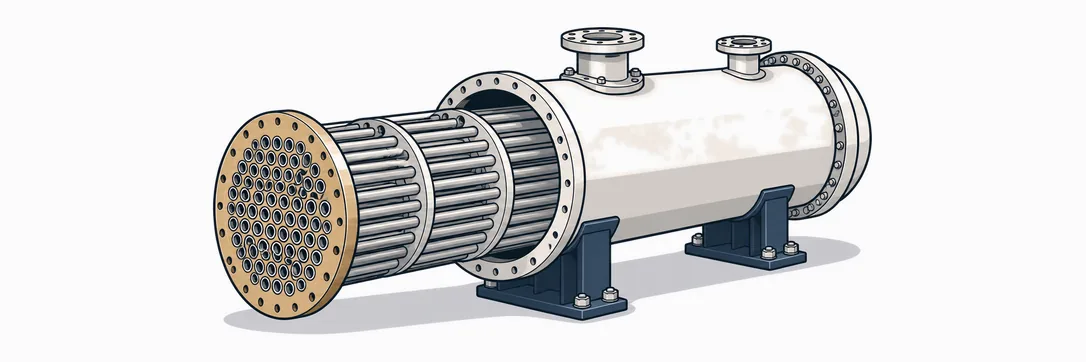
A shell-and-tube heat exchanger built to Section VIII Division 1 is a multi-chamber vessel: the shell and channel follow the usual rules, the tubesheets are designed to Part UHX, and the data report is a U-1 with the U-5 supplementary sheet. Most purchasers also specify TEMA, which adds mechanical standards, tolerances and the type code such as AES or BEM. Each side is pressure tested.
Pujan Motiwala · Written to the ASME BPVC 2025 Edition · checked against ASME's and the National Board's public pages on
Video chapters (10)
- 0:00ASME Shell-and-Tube Heat Exchangers Overview (Part UHX, TEMA & U-5)
- 0:20Multi-Chamber Vessel: Div. 1 Shells/Channels & Part UHX Tubesheets
- 0:44TEMA Classes (R, C, B) & 3-Letter Codes (AES, BEM, BEU)
- 1:02Tube-to-Tubesheet Joints, Leak Tests & Dual-Side UG-99 Hydro Tests
- 1:26Datasheet Verification & Forms U-1 + U-5 vs. Plate Form U-1P
- 1:465 Common Exchanger Defects & Why Exchanger ITPs Carry Extra Holds
- 2:064 Primary Citations: ASME Forms, Part UHX, UG-99 & TEMA Standards
- 2:2660-Point Exchanger ITP (25 Bundle) & NCR-Gated Records in Boiler ERP
- 2:462025 Edition Notice & Authorized Inspector Verification
- 3:00Next Steps: WPS, PQR & WPQ (S34), Section VIII (S08) & Data Reports (S15)
Which ASME rules apply to a heat exchanger?
A shell-and-tube heat exchanger is built as a Section VIII Division 1 vessel with two pressure chambers, the shell side and the tube side. The shell, channel, heads, nozzles and flanges follow the same rules as any Division 1 vessel (shell thickness, heads, joint efficiency). The parts unique to an exchanger, the tubesheets and their joints to the shell and channel, are designed to Part UHX. Plate heat exchangers have their own data report, U-1P.
What does Part UHX cover?
Tubesheet design: the thickness of fixed, floating and U-tube tubesheets under the pressures on each side, the effect of the tubes acting as stays, and for fixed tubesheet exchangers the loads from differential thermal expansion between shell and tubes, which may call for an expansion joint in the shell. It is calculation-heavy and usually done in design software; the shop's job is to build what the calculation assumed (tubesheet thickness after grooving and corrosion allowance, tube pitch and pattern, tube-hole tolerances).
What is TEMA and how does it relate to ASME?
TEMA, the Tubular Exchanger Manufacturers Association, publishes mechanical standards for shell-and-tube exchangers that sit on top of the ASME Code: minimum thicknesses, tube-hole tolerances, baffle and tie-rod rules, nozzle loads and fabrication tolerances. ASME decides whether the exchanger is safe as a pressure vessel; TEMA decides much of how it is built and how it fits the plant. TEMA defines three classes, chosen by the purchaser:
| TEMA class | Typical service |
|---|---|
| R | Severe service, typically petroleum and refinery processing |
| C | Moderate service, general commercial and process use |
| B | Chemical process service |
TEMA's three-letter type code names the front head, shell and rear head: an AES has a removable channel and cover, a one-pass shell and a split-ring floating head; a BEM has a bonnet, one-pass shell and a fixed tubesheet; a BEU is a U-tube bundle. The type code goes on the datasheet and drives most of the bill of materials.
How are tube-to-tubesheet joints made and checked?
By expanding the tubes into the tubesheet holes (roller or hydraulic expansion, with or without grooves), by welding the tube ends, or both (strength-welded and expanded, or seal-welded and expanded). Section VIII gives rules for the allowable load on each joint type. What the inspection and test plan usually holds on:
- tube-hole diameter and ligament checks before tubes go in;
- expansion procedure and its qualification, with wall-thinning checks;
- a qualified WPS and welders for welded joints; mock-up joints when the purchaser asks;
- a leak test of the joints before the shell is closed or the bundle inserted.
How is a heat exchanger pressure tested?
Each chamber is tested to its own hydrostatic test pressure under UG-99, the shell side and the tube side, usually with the other side open so the tube joints can be seen. With a removable bundle, the shell-side test is often done with a test ring so the tube joints are visible. Where the design is for differential pressure only, the test sequence must not exceed the differential the tubesheet was designed for; agree the sequence with the Inspector.
Which data report does a heat exchanger need?
A U-1 for the multi-chamber vessel, with the U-5 supplementary sheet for shell-and-tube exchangers: the sheet records the tubesheets, tubes and tube-to-tubesheet joints, the parts a U-1 has no room for. ASME's forms page lists U-5 among the Division 1 forms. See data reports and the job's data book.
What does an exchanger datasheet tell the shop?
The purchaser's datasheet carries the process side (fluids, flows, temperatures, fouling factors) and the mechanical side that drives fabrication: TEMA type and class, design pressure and temperature on each side, corrosion allowances, materials for shell, channel, tubesheets, tubes and baffles, tube size, gauge, length, pitch and layout, number of passes, nozzle sizes and ratings, and test pressures. A shop should check it against the drawing before material is bought: a tube gauge or tubesheet material that differs between the two is a common source of NCRs.
What fails most often in exchanger fabrication?
- Tube holes out of tolerance or with poor finish, which spoils the expanded joint.
- Over-expansion that thins tubes beyond the procedure's limit, or under-expansion that leaks on test.
- Tubesheet and baffle holes that don't line up, making the bundle hard to insert.
- Leaks at tube-to-tubesheet welds found only on the hydro test.
- Gasket surfaces damaged during handling, found at the final test.
Each is cheapest to catch at its own hold point on the inspection and test plan, which is why exchanger ITPs carry more points than a simple vessel's.
What should an exchanger shop's system keep?
Everything above, per job: the TEMA type and class, tubesheet and tube materials with their MTRs, tube-hole and expansion records, the joint WPS and welders, the leak test, both hydro tests and the U-1 with U-5. Our US boiler demo runs the same quality loop on an exchanger inspection plan (60 points for a full exchanger, 25 for a bundle only): failed inspections hold the next step until the NCR closes, and the data book fills as the job runs. See ERP for boiler and pressure vessel shops. U-5 output is not in the demo yet.
Quoted from the official text (1)
“U-5”
ASME Data Report Forms page
WPS and PQR registers, welder continuity, heat numbers from receipt to nameplate, and the data report package: the records a Code shop keeps, in one system.
A boiler manufacturer's system, from enquiry to dispatch and the IBR folder, with sample logins: try the live demo.
A boiler and pressure vessel shop's system, from inquiry to shipping and the ASME data report package, with sample logins: try the live demo. Fixed price, scope agreed before work starts: see the prices.
Official sources
- Boiler and Pressure Vessel Certification. ASME, November 1, 2026.
- 2025 ASME Boiler and Pressure Vessel Code (Section VIII, Division 1, Part UHX, UG-99). ASME, July 1, 2025.
- ASME Data Report Forms. ASME, November 5, 2026.
- TEMA Standards. Tubular Exchanger Manufacturers Association, November 14, 2026.
What this page is not
A guide written by Ahrom Labs, not engineering advice, and not yet reviewed by an Authorized Inspector. The ASME Code is copyrighted and sold by ASME: paragraphs are cited by number and explained in our own words, never reproduced. Check every figure against your copy of the 2025 Edition and with your Authorized Inspector before relying on it. Last updated .
Talk to us about your systems.
Tell us what's held together with workarounds right now. We reply to every message ourselves.