Industries · Boiler and pressure-vessel manufacturers
Boiler manufacturing ERP and AI assistant for Indian boiler and pressure-vessel makers
Ahrom Labs built the operations system a boiler and pressure-vessel manufacturer runs on — BOM, procurement, stores, plate cutting, production, QC, IBR statutory folders, job costing, GST and TDS accounting, service contracts and a customer portal, in one system. Each boiler's IBR folder takes a few minutes instead of being typed up by hand: the form set follows the boiler model, certificates come from a bank of material test certificates, and a person adds the parts.
Pujan Motiwala · · Updated
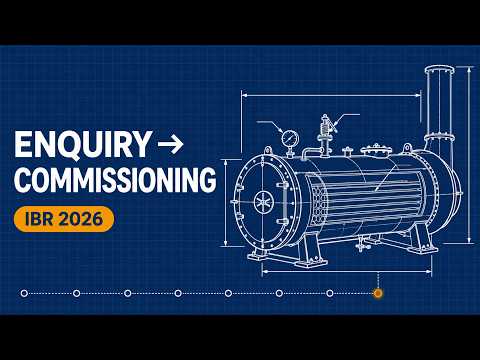 ▶ Watch the demo tourBoiler Manufacturing ERP: Enquiry to Commissioning (IBR 2026)
- IBR forms produced
- Cover letter and IBR 2026 Forms I Part B, IV Part A, IV Part B and V Part B (Forms II(1), III, III A and IV A under IBR 1950)
- Boiler models, each with its own form set
- 8
- Reports and documents
- 23, one computation each
- Live plate-cut test
- 157.00 kg → 127.17 used + 15.70 remnant + 14.13 scrap
- 01 Enquiry to sale order CRM lead, quotation and sale order, with payment stages tracked per order.
- 02 Project and model The boiler model sets the IBR form set; the maker-number prefix sets the legal entity.
- 03 Design and BOM Role-approved drawings, calculation sheets, and a multi-level BOM tree with reusable structure templates.
- 04 BOM release Remnants already in stock are reserved first; only the shortfall goes to Procurement.
- 05 Procurement Requests, sourcing, supplier quotes, selection and purchase orders, with delivery lots per PO.
- 06 Receiving Inward QC approval on each delivery; test-certificate PDFs read by AI into the certificate bank.
- 07 Cutting and production Plates cut into parts, remnant and scrap by weight; work orders and job cards on the shop floor.
- 08 Quality Incoming and finished-goods inspection, hold points, NCRs, calibration; certificates matched to parts.
- 09 IBR folder and dispatch Statutory folder put together from the certificate bank; packing list approved by QC and Production; e-way bill and freight captured.
- 10 Accounts and after-sales Invoice, GST and TDS in the same ledger; service calls, contracts and service reports after commissioning.
Can I try it before talking to anyone?
Yes. A live demo runs at boiler-erp.ahromlabs.com with a made-up company, Acme Boilers, and sample orders already moving through design, procurement, stores, production, QC and dispatch. Leave a name and email, pick a department head to log in as, and use the real screens: open a project, raise a purchase request, download a purchase order or packing list PDF. Emails and WhatsApp are switched off, and the data resets every night, so nothing you do there reaches anyone.
What does a boiler manufacturer need that a generic ERP doesn't give?
Four things generic ERPs treat as edge cases are the core of this business. Every boiler is its own project, with its own bill of materials and a chain of milestones across design, procurement, stores, production, QC, dispatch and commissioning. Every plate and tube has to trace back to the material test certificate it arrived with. Every unit ships with statutory paperwork for the Directorate of Boilers under the Indian Boiler Regulations. And steel plate is bought in standard sizes and cut, so stock is pieces with dimensions, not a count. The system Ahrom Labs built for a boiler and pressure-vessel manufacturer is designed around those four facts rather than bolted onto a generic stock-and-invoice model.
Can the IBR statutory folder come out of the system instead of being typed?
Yes, in a few minutes instead of typing it up by hand. The folder — covering letter, Forms II(1), III, III A and IV A under IBR 1950 numbering (Form I Part B, IV Part A, IV Part B and V Part B under IBR 2026) — comes out of the system, with the form set chosen by boiler model and every part linked to its material test certificate from the bank. A person adds the parts to the folder in a few minutes per boiler; the bill of materials kept for buying and production doesn't fill the forms reliably on its own. Certificate PDFs are read by AI on upload, and matching a certificate to the part it covers is suggested by confidence but always confirmed by a person, because it ends up in paperwork an inspector relies on. The details are in Keeping test certificates for a boiler's IBR folder.
How is material traced from test certificate to finished boiler?
Each test certificate is identified by certificate, cast and plate number together — one certificate number covered four casts in the client's own sample — and one certificate is typically used across several boilers. When a plate is cut, every used piece, remnant and scrap piece is chained to the plate it came from. QC records heat and lot numbers, non-conformance reports with a disposition and a verification step before closing, and hold points that stop a job until inspection clears it.
The heat number and certificate are captured once, when a plate is received, and every piece cut from it inherits them automatically — nobody re-types them at the cutting table. A non-conformance can be dispositioned as rework, repair, scrap or use-as-is: rework and repair open a new job card that carries the lineage of the original, and scrap or use-as-is can't be saved without a written justification. Hold points come from the work order's own route — a step marked as a quality checkpoint holds the job until QC releases it — so there is no separate inspection plan to keep in step with production.
Shops that also build to the ASME Code need the same trail for its material rules: see material test reports and heat numbers, and ASME vs IBR 2026 for where the two codes meet. Exporters to the US can start with what a buyer there checks (buying ASME equipment from India), the sections of the ASME Code and Section IX welder qualification.
How does work move between departments without chasing people?
Each project's milestones declare what they depend on, and the system shows what each one is waiting for, computed fresh every time the page is opened. Procurement runs as a visible pipeline — requests, sourcing, supplier selection, purchase order issued, closed — with new-item requests from engineering accepted into procurement rather than appearing unannounced. On the shop floor, work orders and job cards carry production; engineering has its own calculation sheets linked to the drawings they substantiate.
What did each boiler actually cost, and what did we make on it?
Once a sale order has its project, the system shows its actual cost against its selling price. Material cost is the sum of purchase orders actually issued against that project — drafts and cancelled orders don't count as spend. Labour cost is the time logged on the project's job cards multiplied by each employee's cost rate. Margin is the sale order value minus both. When nothing has been bought or logged yet, material and labour show as empty rather than as an estimate.
Work orders carry a planned cost as well as an actual one: planned material from the quantities and unit costs on the work order, planned labour from each route step's planned minutes and the workstation's machine-hour rate. The gap between the two is the Production Cost Variance report. For management, Project Profitability and Customer Profitability run the same costing across every order in a period, so there is one calculation of margin, not three that disagree.
Costing is only as complete as its inputs. Purchase orders and job-card time are counted; outside job work is listed but not priced, overheads aren't allocated yet, and a margin is only real once purchasing and time logging are actually happening in the system.
What can the owner see across all orders?
Each department has its own reports, and the management reports reuse those numbers rather than recalculating them:
- Project and customer profitability — material and labour against selling value, per order and per customer.
- Manufacturing performance — work-order throughput, rejection rate, material yield and cost variance.
- Procurement spend — by supplier, with a six-month spend trend and each supplier's win rate on quotes.
- Working capital — cash plus receivables plus inventory, minus payables.
- Production — work order register, rework and rejection, material and labour utilisation, and material shortage against open work orders.
- Sales — leads, conversion rate and follow-up completion per salesperson.
The management reports export to PDF from the same computation the screen shows. Machine downtime and OEE are deliberately left out: no machine data is collected, so there would be nothing honest to report.
What can an AI assistant do for an Indian boiler manufacturer?
Ember AI is the assistant inside this boiler ERP. What it does today, and what is still being built, kept apart:
-
Live on the boiler demo: how-to answers from the system's own help guide ("how do I raise a purchase request?", "how do I assign test certificates to units?"); 99 everyday changes a person confirms, such as logging a follow-up, recording a payment against a sale order, closing a milestone or issuing material; and live-data questions on stock, purchase orders, order value and payments. In a client's system the live-data answers stay off until the owner approves them.
-
Live on the demo for owner, sales and marketing logins: a steel purchase what-if on each order. Should you buy boiler-quality plate now or wait? It shows the steel cost against the quoted rate and the interest on the order's cash gap at your own borrowing rate, as two separate amounts. The AI never does this arithmetic; it points to the calculator.
-
Built by Ahrom Labs on sample boiler orders, not in Ember yet: a daily review of up to three issues worth checking, each with the records behind it and what to check next:
- Steel and material price exposure for each material still to buy (plates, pipes, fittings), from the BOM, reserved stock, fixed-price purchase orders and the rate in your quotation. A price index is treated as a proxy, not your supplier's price, and is used only where a person has approved the mapping.
- Milestone delays that hold up dispatch and the milestone payments waiting on them, never called a loss.
- Unpaid milestone payments after the work was completed.
- Financing cost of buying material early, only when you have entered your own borrowing rate.
When the records are not enough, it says what is missing instead of guessing, and "nothing to review today" is a valid answer.
More on how it handles money, data and approvals: AI assistant for manufacturers.
Which installed boilers are due for service, and are contracts being renewed?
After commissioning, each boiler stays in the system as the equipment its service calls and contracts attach to. A service call carries a priority and a response time in hours, and moves from open to assigned, in progress, resolved and closed; the resolved and closed times are stamped by the system at the moment the status changes, so response times can't be edited after the fact. Every site visit is logged against its call.
A service contract records its coverage window, visit frequency and what is covered. Renewing one creates a new contract linked to the old one rather than overwriting it, so the history of what was covered, and when, survives. Four reports come off that data: commissioning progress and delay reasons; service calls by priority with response-time compliance; each technician's calls and average resolution time; and active contracts, contracts expiring in the next 30 days, and the renewal rate.
What happens to plate offcuts?
They go back into stock as real pieces with dimensions, and every weight is derived from geometry rather than typed. In a live test, a 157.00 kg plate became 127.17 kg of parts, a 15.70 kg remnant returned to stock, and 14.13 kg of scrap — summing exactly to the source. When a BOM is released, a fitting remnant is reserved before anything is bought. See Putting steel plate offcuts back into stock.
Can GST, TDS and accounts live in the same system?
They do here. The system is the book of record — ledger, GSTR-1 and GSTR-3B, input-tax-credit reconciliation, TDS, reverse charge, fixed assets, bank reconciliation, a books lock and an audit log — with Tally available as an optional sync target. The original plan left regulated accounting to a separate ERP package; in August 2026 that was reversed, and the operations system became the book of record. See GST, TDS and the general ledger inside a manufacturing ERP.
GST, TDS, income-tax, professional-tax and PF/ESI rates aren't typed in per company: the system pulls them daily from a central registry where each change is checked against the actual notification and approved by a person before it goes live — see Keeping GST, TDS and income-tax rates current across every system. The government's GSTR-2B is imported from the portal's download, with each line's accept or reject status recorded. For dispatch, an e-way bill client that talks directly to the government's NIC system is built to the official specification and goes live once the company's NIC account is set up.
What does the customer see?
A read-only portal: each order as a stepper from order received to commissioning, with overall progress, estimated dispatch, and the QC certificates and packing lists filed under the stage they belong to. A customer only ever sees their own orders.
Can it stop drawings leaving the office on a USB drive?
The same system runs a device-control layer on office PCs. USB drives, CDs and DVDs, phones and chosen websites are blocked by default; an employee's attempt to use one files a request, a manager approves it with a one-time code, and access opens for a time-boxed window — 15 minutes by default. Every step is audited.
What modules does a boiler manufacturer's ERP need?
One per department, sharing the same records rather than handing spreadsheets between them. In the system built for that manufacturer:
- Sales and CRM — leads, quotations, sale orders and a payment tracker with stages per order.
- Engineering — a multi-level bill of materials with where-used and common/uncommon views, engineering change notes, reusable structure templates, drawings approved by role, and calculation sheets linked to the drawings they substantiate.
- Procurement — requests from engineering accepted into a sourcing pipeline, supplier quotes compared side by side, purchase orders with delivery lots, and purchase returns.
- Stores — delivery-by-delivery receiving, piece-level plate and section stock with remnants, material indents and gate passes.
- Production — work orders above job cards, routed per unit when one order covers several boilers.
- Quality — incoming, finished-goods, sub-assembly and job-work inspection, instrument calibration, non-conformance reports with disposition, hold points, and the test-certificate bank behind the IBR folder.
- Dispatch — packing lists that need both QC and Production sign-off, freight cost and e-way bill details captured against the invoice.
- Accounts — ledger, GST returns, TDS, reverse charge, fixed assets and bank reconciliation, with 23 reports.
- Installation — service calls with priorities and response times, service contracts, and service reports.
Can existing Excel records come across?
Yes, and they were. Bills of materials are imported from the plant's own spreadsheets into the BOM tree, with each line categorised automatically — and when a person corrects a misspelled item once, the import remembers it. Five years of order and payment history came across from the existing Excel tracker and were checked field by field against the sheet, with zero mismatches, before anyone relied on them.
Should a boiler maker buy an engineering ERP package or build custom?
Engineering ERP packages exist with hundreds of installations, and if one fits your processes with little customisation, it will be cheaper and faster. The system was scoped against one such package's feature list, item by item — then built custom, because the parts that matter most here (the IBR folder built from a bank of test certificates, piece-level plate traceability, a customer portal filed by boiler stage) aren't what packages are built around. The trade-offs in general are in Tally, ERPNext, Odoo or a custom ERP.
Can we ask it from ChatGPT or Claude?
Yes. SB Ops has an MCP connector, so ChatGPT, Claude or any AI app that supports MCP can sign in as one of your people and ask Ember AI what they would ask in the app, by text or, where the AI app supports it, by voice. Answers come from the same fixed look-ups and the same permissions as the screens, and any change still needs that person's yes. You choose the writing model from the hundreds OpenRouter offers, pay for it on your own key, and see the credit used in Settings, with a daily limit you set. The connector is switched on once you approve it; it is off in the public demo. See Ember AI for your business and MCP for ERP.
What should a boiler maker ask any software vendor?
Whoever builds or sells it, these five questions separate a system that fits from one that gets worked around:
- Where does money leak today? Late quotations, cost overruns, slow collections or unbilled service work — the system should be designed around the biggest one first.
- Can it show the real cost of one boiler? Material and labour against selling price, per order, from the purchase orders and job cards themselves — not from a spreadsheet kept on the side.
- Can it produce the statutory and quality paperwork from its own records? The IBR forms, test certificates, inspection results and non-conformances, traced to the parts they cover.
- What happens after dispatch? Service calls, visits and contracts against the specific boiler, with renewals that keep their history.
- Who owns the system and the data? The code, the server and the records — and what it takes to change something next year. Our answer is in Working with Ahrom Labs.
IBR terms, in one place
The Indian Boiler Regulations, 2026 renumbered the folder's forms on 1 October 2026. The client's folders were filed under the IBR 1950 names, given in brackets; every form and its old name is on the IBR 2026 forms list.
- Form I Part B (was Form II(1)) — the inspection certificate: inspecting authority, pressures, hydraulic test pressure and date, drawing numbers and signatories.
- Form IV Part A (was Form III) — the boiler's description: dimensions, pressures, heating surface, evaporation, parts manufactured, construction and seams.
- Form IV Part B (was Form III-A) — the certificate for pipes; in the client's folders, a material table for one named part such as the feed pipeline, with steel-making process and heat treatment.
- Form V Part B (was Form IV-A) — the extract of every material test certificate used in the boiler, grouped into lettered sections.
- Form XXII (was Form XVII) — the certificate of manufacture and test for a small industrial boiler.
- Material test certificate (MTC) — the mill's certificate for a plate, tube or forging, identified here by certificate, cast and plate number together.
- Hold point — a stage production can't pass until QC clears it.
- NCR — a non-conformance report, closed only after a disposition and a separate QC verification.
Boundary
Nesting — planning the layout of several parts on one plate — is not part of the system. E-invoicing is researched and deferred. Quotations are priced from default and customer price lists; there is no configurator that builds a price from a boiler's specification, and a pre-sale cost estimate was deliberately left out, because nothing real exists to cost before an order becomes a project. Welding is tracked as a job-card operation, not joint by joint — there is no weld map, WPS or welder-qualification record, or NDT result linked to a joint yet. Remote monitoring of installed boilers (sensors, IoT, SCADA) is not part of this system. The generated IBR forms have been checked against the client's real filed documents; the remaining gaps are formatting, and are being closed form by form.
Writing down what a system must do before you buy one? The ERP requirements for this kind of business, each with the test to ask any vendor for.
Thinking of an AI assistant on top? What it should answer for this kind of business, and how to check it doesn't invent numbers.
See it with a sample company before you talk to anyone.
The engineering notes
- Keeping test certificates for a boiler's IBR folder
- Putting steel plate offcuts back into stock, by weight derived from geometry
- GST, TDS and the general ledger inside a manufacturing ERP, with Tally optional
- The same confidence score, two different autonomy rules
- Tally, ERPNext, Odoo or a custom ERP: how a manufacturer should choose
- Keeping GST, TDS and income-tax rates current across every system
- What a customer sees: one boiler order through every department
- Suppliers quote on a link, not a login, and see their PO when it's issued
- Moving five years of sales history into one CRM, without guessing a single customer
Services
- Custom ERP, CRM and operations systems
- GST, TDS and statutory compliance, built in
- Analytics and operational intelligence
- AI document extraction with human review
- Sales CRM, enquiries and quotations
- Customer portal and online quote requests
- Supplier RFQ portal and purchase orders
- Material traceability, cutting and remnant management
- BOM import and multi-level bill of materials
Built for
Decisions behind it
- Compute "what's blocking this" on every read, and observe before you enforce
- Let one deliberate human correction teach the system — but only for narrowly trusted error shapes
- Mark inferred rules unconfirmed, and keep them read-only until a person confirms them
- Keep statutory rates in one human-approved registry that deployments pull from — don't scrape them
- Auto-apply a match only when it's mutually unique — everything else goes to a person
- One computed result, several renderers — never recalculate a report per format
Talk to us about your systems.
Tell us what's held together with workarounds right now. We reply to every message ourselves.